Anthropic's Own Data: Junior Tech Hires Fell From 27% to 9% as AI Agents Hit 6x Human Hours
On October 16, 2026, Anthropic published a rare inside look at how AI has changed its own workforce: a much smaller share of junior technical hires, AI agents logging six hours for every human hour, five times more code per engineer, and human attention as the new bottleneck. Two days later it pledged 5% of its shares to a new Public Benefit Fund, with AI's impact on jobs as a named focus. Here is what the data says and what it means if you are starting a tech career.

What happened
On October 16, 2026, Anthropic's economists published How employment is changing at Anthropic, a report by Nathan Wilmers, Regina Catipon, Maxim Massenkoff and Peter McCrory. It draws on Anthropic's internal employment records, agent telemetry, output metrics, employee surveys, calendar data, Slack patterns and hiring score cards, plus 17 employee interviews. The company's argument: because it has rebuilt its own workflows around Claude, it may be an early signal of how AI will reshape work elsewhere.
Two days later, on October 18, Anthropic announced the Anthropic Public Benefit Fund, which names AI's impact on the labour market as one place the money could go. This page is the long-form briefing behind the BSH Technologies Instagram carousel.
1. The hiring drop: 27% to 9%
- Junior hires. The share of junior technical hires at Anthropic fell from 27% to 9%. The share of junior employees in technical departments slipped from 21% to 14% since early 2025 (Figure 1 in the report). Postings for junior roles fell especially sharply after December 2025.
- When it started. Talk of falling demand for junior technical staff began in core technical teams in January 2026, as writing code and finding bugs could increasingly be handed to Claude. By April, engineering and research teams had deemphasised hiring for lower-band technical roles.
- Managers agree. In an April survey, most managers said they were hiring for a different set of skills because of AI. Around a third of machine-learning managers and a fifth of software-engineering managers said they were hiring less because of AI.
- Still growing. Technical hiring kept rising in absolute terms, but the technical share of all employees fell from 61% to 56% in a year as sales, finance and recruiting grew faster. Anthropic says it brings in two to four times more revenue per employee than Meta and Google did at the same stage.
2. The agent shift: 6 agent hours per human hour
- Crossing point. In March 2026, the combined hours worked by autonomous and interactive agents passed human work hours for the first time.
- By August. Counting only the interactive agents that employees direct themselves, agents worked six times as many hours as their human handlers. In research organisations the chart shows about 19 times. Anthropic measures agent runtime as inference plus active tool use, excludes waits longer than 30 minutes, pools subagents, and assumes 40 human hours per week.
- Everywhere, not just code. Most tokens go to writing software, but personal-assistant agents also schedule meetings, collect to-do lists and brief employees before meetings. Agents appeared in nearly half of active public Slack channels.
3. The output: 5x more code per engineer
- Code. Code commits per engineer rose fastest, to about 5 times their level six months earlier. Queries per data scientist and contracts per legal employee rose about 3 times; deals per salesperson about 1.7 times.
- Is it really AI? To separate AI from Anthropic's booming business, the researchers followed 192 engineers as they adopted coding agents and compared them with 74 who had not. Code added rose sharply after adoption.
- Quality check. Comparing code written by the same person, in the same month and directory, by hand versus by their agent, the report found no difference in how often lines were later removed or reverted.
- Non-coders code now. Coding-agent sessions by non-technical employees jumped from 2 a month in August 2025 to 90 in May 2026.
4. The bottleneck: humans
- Waiting. In interactive sessions, Claude spends around 80% of the time idle, waiting for a human to respond. One engineer described it as facing "an army of Claudes, with every one asking for my attention."
- Too much to read. Even for non-technical teams, reading all the output of their interactive Claude sessions would take more than half the work week.
- Meta-work. Building tools, specs and monitors for agents rose from 10% of the average employee's interactive sessions in fall 2025 to 22% in spring 2026. Written standing instructions for agents grew from a few hundred in July 2025 to 8,500 a year later.
- More meetings. The median employee spends 20% more time in meetings than a year ago, and technical individual contributors 16% more.
5. What hiring managers now look for
- AI tooling. In 2024, interviewers mentioned a candidate's record with AI tools in about 5% of technical and 7% of non-technical assessments. By 2026 those rates had tripled for technical roles and quadrupled for non-technical ones.
- Autonomy and judgment. For technical candidates, the biggest increases were in comments on autonomy and judgment, while domain expertise shrank as a share of the assessment. For non-technical roles, customer and mission orientation rose and execution skills fell.
- Expectations. In August, Anthropic employees expected AI to be able to do 75% of their work by 2030, compared with 28% for other Americans.
6. The response: 5% of Anthropic's shares
- Inside the company. The report says Anthropic set up an early warning system to flag jobs at risk of disruption and prioritises moving affected people into other roles. Employees with at least a year at the company were 50% more likely to move departments each month in 2026 than in 2025. Anthropic admits none of this helps the juniors who are never hired, and says government policy on retraining and income support is needed too.
- The fund. Per Anthropic's October 18 announcement, subject to stockholder approval, 5% of its shares go to the Anthropic Public Benefit Fund now, and the board may add 2% more for every 50% increase in the company's value above a set baseline.
- Jobs as a focus. Anthropic names labour-market impacts as one example of where the fund could act, on top of the $200 million it has already committed to studying and addressing the issue.
- Structure. The fund is a wholly owned LLC rather than a 501(c)(3), so it can switch between forms of giving such as large nonprofit donations or direct distributions. Its Anthropic equity cannot be used for lobbying or political giving. With co-founder and employee pledges, Anthropic says roughly 20% of its shares are now dedicated to the public good. Coverage: CNBC and AP.
What it means if you are starting out
This is one company, and an unusual one: it builds the models, it is growing fast and it is all-in on agents. But it is first-hand data, and it points the same way as outside research. Entry-level tasks such as routine coding and bug-finding are the first to move to agents, so the skills that stand out are the ones agents lack: owning a problem end to end, judging what good output looks like, reviewing and steering agent work, and working well with people. Learning to use AI tools seriously, and showing it, is now part of the interview.
As TechCrunch summed it up, Anthropic's workforce has become less junior and is spending more time in meetings.
Sources
- Anthropic: How employment is changing at Anthropic (Oct 16, 2026)
- Anthropic: Investing in the public benefit (Oct 18, 2026)
- TechCrunch: Anthropic says its workforce has become less junior and is spending more time in meetings
- CNBC: Anthropic to commit 5% stake to new public benefit fund
- AP: Anthropic commits 5% of its stock to a new 'public benefit' fund
Frequently asked questions
What did Anthropic's employment report find?
Published October 16, 2026, it found that the share of junior technical hires at Anthropic fell from 27% to 9%, junior staff fell from 21% to 14% of technical departments since early 2025, interactive AI agents worked six hours for every human hour by August 2026, and code commits per engineer reached about five times their level six months earlier.
What does '6 to 1' agent hours mean?
Counting only the interactive agents employees direct themselves, agent runtime (inference plus active tool use, excluding waits over 30 minutes, with subagents pooled) was six times the human work hours, assuming 40 hours per employee per week. Total agent hours first passed human hours in March 2026.
Is AI-written code at Anthropic lower quality?
On the measures Anthropic used, no. Comparing code by the same employee in the same month and directory, it found no difference in how often agent-written and hand-written lines were later removed or reverted. It notes AI errors may be harder to spot.
What is the Anthropic Public Benefit Fund?
Announced October 18, 2026, it is a wholly owned LLC that will receive 5% of Anthropic's shares, subject to stockholder approval, with the board able to add 2% for every 50% rise in the company's value above a baseline. AI's impact on the labour market is a named focus, and its equity cannot be used for lobbying or political giving.
What skills do Anthropic's hiring managers now value?
Interview notes increasingly focus on autonomy and judgment, and on creative use of AI tools, which interviewers mention three to four times as often as in 2024. Discussion of narrow domain expertise and execution skills has shrunk.
From the blog
View all posts
DeepSeek V4.1-Flash-1017: The Open MIT Model That Tops Opus 5 on DeepSWE, Plus a $0.75 Search API
On October 17, 2026, DeepSeek upgraded its Flash model to V4.1-Flash-1017, an open-weight MIT-licensed update that scores 77.0 on DeepSWE v1.1, ahead of Claude Opus 5 in DeepSeek's own table, while finishing tasks faster with shorter outputs. It also opened its in-house search engine to developers at $0.75 per 1,000 calls. Here is the model, the benchmarks, the memory trick, the new API and the price.

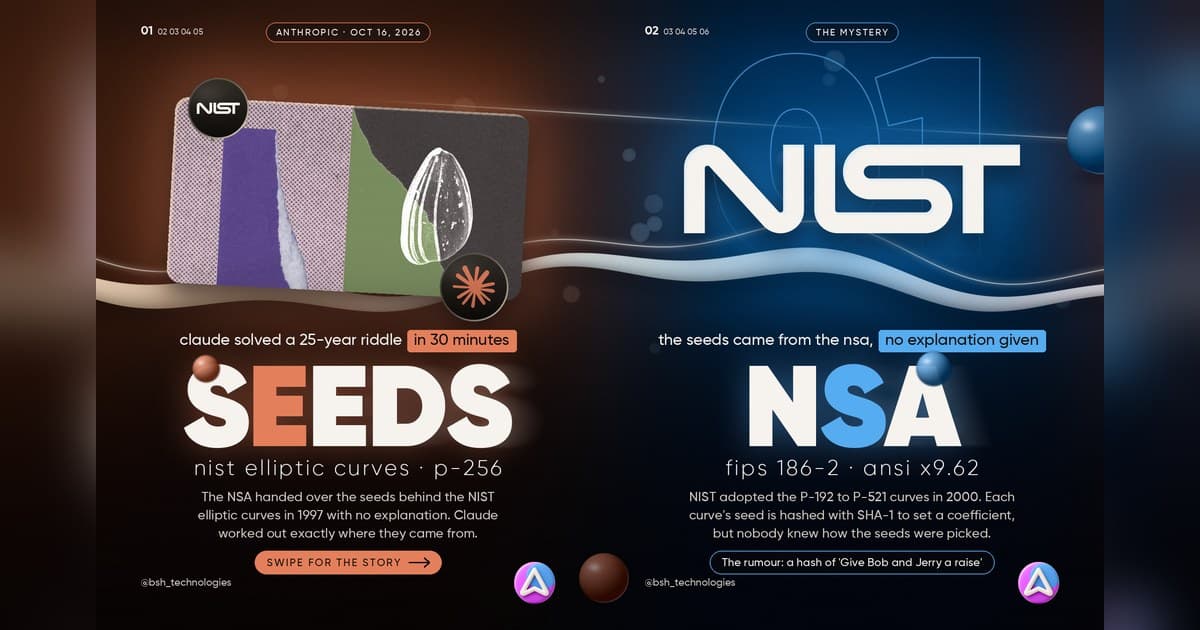
Claude Solved the 25-Year Mystery of the NIST Elliptic Curve Seeds
On October 16, 2026, Anthropic said Claude worked out in under half an hour how the NSA-supplied seeds behind the NIST P-curves were made: not a hashed passphrase, but output of the C library's lrand48 generator seeded with 1997-98 Unix timestamps. Here is the riddle, how Claude cracked it, why it rules out a backdoor, and what is still unexplained.