Hugging Face's Carbon-X: an Open Model You Can Chat With About DNA, Near GPT-6.1 Sol Scores at a Fraction of the Cost, and Its Limits
On October 22, 2026, Hugging Face released Carbon-X, an open 14.8B-parameter model that reads raw DNA inside an ordinary chat and answers in English. It averages 66.7% on five DNA benchmarks, close to GPT-6.1 Sol's 67.5%, at about 1/1,800 of the inference cost per problem. Here is how it works, the numbers, what it costs, how to run it locally and what it cannot do yet.
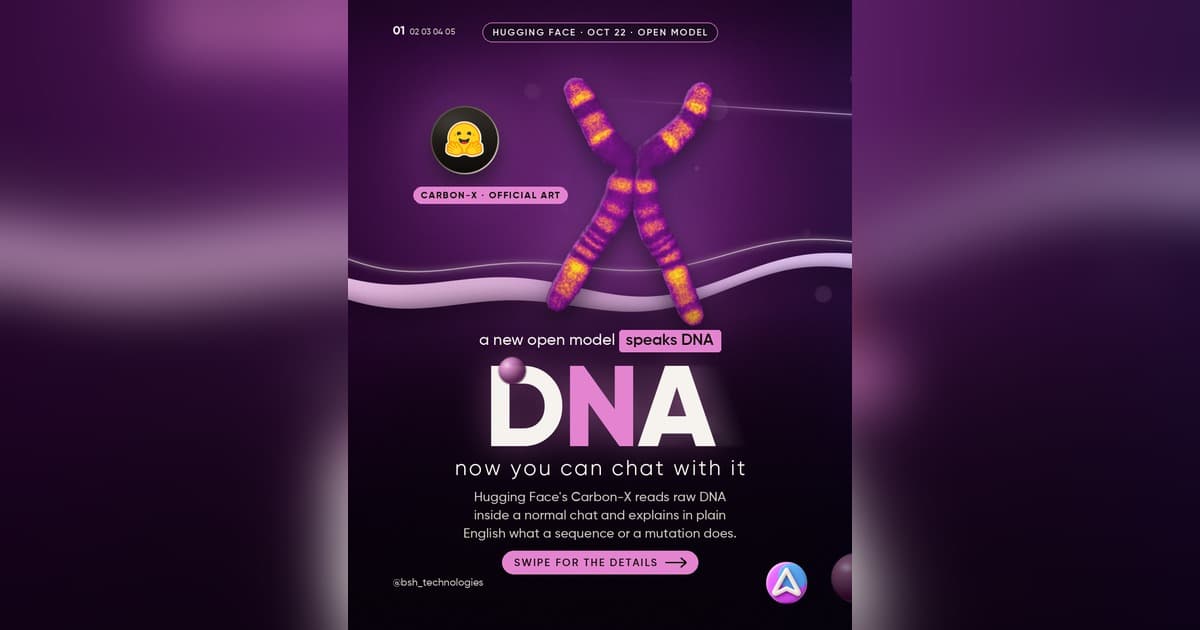
What happened
On October 22, 2026, Hugging Face released Carbon-X, the first model in its new Carbon family, together with a launch post, Carbon-X: When Natural Language Meets DNA. Carbon-X is an open, 14.8B-parameter language model trained jointly on DNA sequences and natural-language text. You paste raw DNA into a normal chat and it answers in English. It was built with research teams at Zhongguancun Academy and the Telethon Institute of Genetics and Medicine (TIGEM) / University of Naples Federico II. This page is the long-form briefing behind the BSH Technologies Instagram carousel.
- What it does: predicts whether mutations are benign or pathogenic, identifies regions that control gene activity, classifies sequences by organism group, predicts the next bases of a sequence, and explains its reasoning.
- Headline score: 66.7% average across five DNA benchmarks, versus 67.5% for GPT-6.1 Sol and 60.9% for Opus 5.5.
- Cost: about 1/1,800 of GPT-6.1 Sol's inference cost per problem, by Hugging Face's estimate.
- Licence: Apache 2.0, with weights that fit on a single 80 GB GPU.
1. How it works: one model, two alphabets
- One decoder, no separate DNA encoder. DNA and text share a single token stream. Earlier DNA models usually bolt a separate sequence encoder onto a language model.
- A hybrid tokenizer. Text uses the Qwen3 BPE vocabulary, while DNA is cut into non-overlapping 6-mers, so one token covers six base pairs. That adds 5,515 DNA tokens: all 4,096 possible 6-mers, 1,364 tail tokens for sequences whose length is not a multiple of six, and tag markers. DNA in a prompt is detected and tagged automatically.
- Built on Qwen3-14B. Hugging Face first trained only the new DNA embeddings for about 10B tokens, then mid-trained the full model on 302B tokens: 55% raw DNA (vertebrate, mammal, plant, fungal and prokaryotic genomes plus mRNA), 20% English web and PDF text, 15% biology text and 10% instruction data.
- Then fine-tuning and RL. Supervised fine-tuning on 20 dataset subsets (about 30% variant-effect reasoning) was followed by two rounds of GRPO reinforcement learning with code-checked, verifiable rewards. The model answers directly, with "thinking" disabled, which keeps each answer short and cheap.
- Context window: 40,960 tokens, though Hugging Face has not evaluated inputs much longer than the roughly 49 kbp of DNA seen in training.
2. The scores
- Average of five benchmarks: Carbon-X 66.7%, GPT-6.1 Sol 67.5%, Opus 5.5 60.9%, Kimi K3 50.4%, Gemini 4 Argon 49.8%, DeepSeek V4.1 Flash 47.1%, GLM-5.3 39.8%. Comparison models are shown at the reasoning effort with their best average.
- Where it leads every model tested: coding-variant effects (BioReason Coding, 74.9 vs 71.0 for GPT-6.1 Sol) and next-base prediction (NextBase, 39.4 vs 32.9).
- Where it trails: complex non-SNV variants (85.1 vs 94.8 for Opus 5.5), DNA understanding questions (GenomeQA, 63.6 vs 67.2) and single-base variant effects (FrontierVEP, 70.4 vs 76.2).
- The gain from training: 27 points above Qwen3-14B, the model it starts from, and ahead of every other open model Hugging Face evaluated. It still works as a general assistant, at 79.3% prompt-level strict accuracy on IFEval.
- Training data was decontaminated against the benchmarks with DNA overlap, text n-gram and sequence homology checks. Two of the five benchmarks, FrontierVEP and NextBase, were built by Hugging Face itself.
3. The cost
- Because Carbon-X answers without extended reasoning, each problem costs few output tokens. Hugging Face puts it at about 1/1,800 of GPT-6.1 Sol's inference cost per problem, using standard API prices for the frontier models and measured throughput on an H200 at $5 an hour for Carbon-X.
- The ClinVar example: analysing the 2.4 million variants of uncertain significance in ClinVar would cost about $300 with Carbon-X, against $32,000 to $4 million with the frontier models evaluated.
4. Running it yourself
- Open weights, Apache 2.0. The bfloat16 weights fit on one 80 GB GPU and serve with vLLM or Transformers v5, so researchers can keep sensitive or unpublished sequences on their own infrastructure.
- GGUF builds. Carbon-X-GGUF offers quantisations from BF16 (29.7 GB) down to Q4_K_M (9.6 GB), with Q8_0 (15.8 GB) recommended. They need llama.cpp release b11742 or newer, the first with support for Carbon's hybrid DNA tokenizer; older builds tokenize DNA wrongly. Hugging Face's official demo runs the Q8_0 file in llama.cpp on an Apple M5 Max.
- As a tool for agents. The model card includes a ready-made skill for coding agents such as Claude Code and Codex CLI, and examples for calling Carbon-X from any tool-calling agent. Training and evaluation code is on GitHub.
5. The catch: what it cannot do yet
- Not clinically validated. Hugging Face says Carbon-X is a starting point for research and should not be used to make medical decisions.
- No lab confirmation. As WIRED reports, its predictions have not been tested in wet-lab experiments.
- Exact operations. It can miscount bases, confuse coordinates or make wrong edits in long sequences, and may invent a sequence's identity when context is missing. Splice-site (29.8%) and histone-mark (34.6%) questions remain weak, and it was not trained to design new DNA.
- Self-reported results. The benchmark numbers and cost estimates come from Hugging Face's own evaluation; The Next Web notes they have not been independently verified.
- Biosecurity by design. Viral genomes were left out of the training data, according to WIRED, to limit misuse.
- Sensitive data. Genetic data is highly sensitive. Hosted demos and third-party inference providers may handle it differently from a local install.
Why it matters for businesses
Carbon-X shows a pattern that travels well beyond genomics: a mid-sized open model, specialised on domain data and verifiable rewards, can get close to the best frontier model on its niche at a tiny fraction of the cost, and can run on hardware a company controls. For biotech, diagnostics and research teams the practical step is to treat it as a fast, cheap first-pass screener whose outputs are checked by code and by experts, not as a clinical decision maker.
Sources
- Hugging Face: Carbon-X model card
- Hugging Face: Carbon-X, When Natural Language Meets DNA (launch post, Oct 22, 2026)
- Hugging Face: Carbon-X GGUF quantisations for llama.cpp
- GitHub: huggingface/carbon
- WIRED: Hugging Face's New AI Biology Model Lets You Chat With DNA
- The Next Web: Hugging Face releases Carbon-X, an AI model for questions about DNA
Frequently asked questions
What is Carbon-X?
Carbon-X is an open 14.8B-parameter language model from Hugging Face, released on October 22, 2026, that is trained on both DNA and text. You paste raw DNA into a chat and it answers in English, for example whether a mutation is likely benign or pathogenic.
How does Carbon-X read DNA?
A hybrid tokenizer keeps the Qwen3 text vocabulary and encodes DNA as non-overlapping 6-mers, so one token covers six bases. DNA and text share one decoder, with no separate DNA encoder. It was built from Qwen3-14B and trained on 302B tokens of DNA, English, biology text and instructions.
How good is Carbon-X?
It averages 66.7% across five DNA benchmarks, against 67.5% for GPT-6.1 Sol and 60.9% for Opus 5.5, and it leads every model Hugging Face tested on coding-variant effects and next-base prediction. These are Hugging Face's own results.
How much does Carbon-X cost to run?
Hugging Face estimates about 1/1,800 of GPT-6.1 Sol's inference cost per problem. Screening ClinVar's 2.4 million variants of uncertain significance would cost about $300, against $32,000 to $4 million with frontier models.
Can Carbon-X be used for medical decisions?
No. It has not been clinically validated or tested in wet-lab experiments, it can miscount bases and hallucinate a sequence's function, and Hugging Face says it should not be used for medical decisions.
From the blog
View all posts
Microsoft's MAI-DxO in Science: an AI 'Panel of Doctors' That Out-Diagnosed Generalist Physicians 83% to 36%, and What It Still Can't Prove
On October 22, 2026, Microsoft AI published its MAI Diagnostic Orchestrator (MAI-DxO) research in Science. On 304 hard New England Journal of Medicine cases it reached 83% accuracy, against 36% for generalist physicians using references, while ordering cheaper tests. Here is how the virtual doctor panel works, the numbers, the cost, the upcoming Boston patient study, and the limits.


Claude Duet: Anthropic's Proactive Agent App That Messages You First, Works While You're Away and Asks Before It Acts
On October 21, 2026, Anthropic opened a research preview of Claude Duet, a standalone app where Claude works as a proactive agent for professionals and small business owners. It sends a morning brief, watches your connected apps, runs tasks on its own cloud computer and waits for your approval before it sends, pays, signs or deletes. Here is how it works, what it connects to, the safeguards, and the limits.