Meta Muse Spark Open: An 816B Open-Weight Model That Runs on Two Mac Studios
On October 15, 2026, Meta released the weights for Muse Spark Open, an 816B-parameter mixture-of-experts model it calls the most capable US open-weight model to date, and worked with Apple so it runs locally on two M5 Ultra Mac Studios. Here is what the model is, what it takes to run, how fast it is, where it trails rivals and what the license allows.
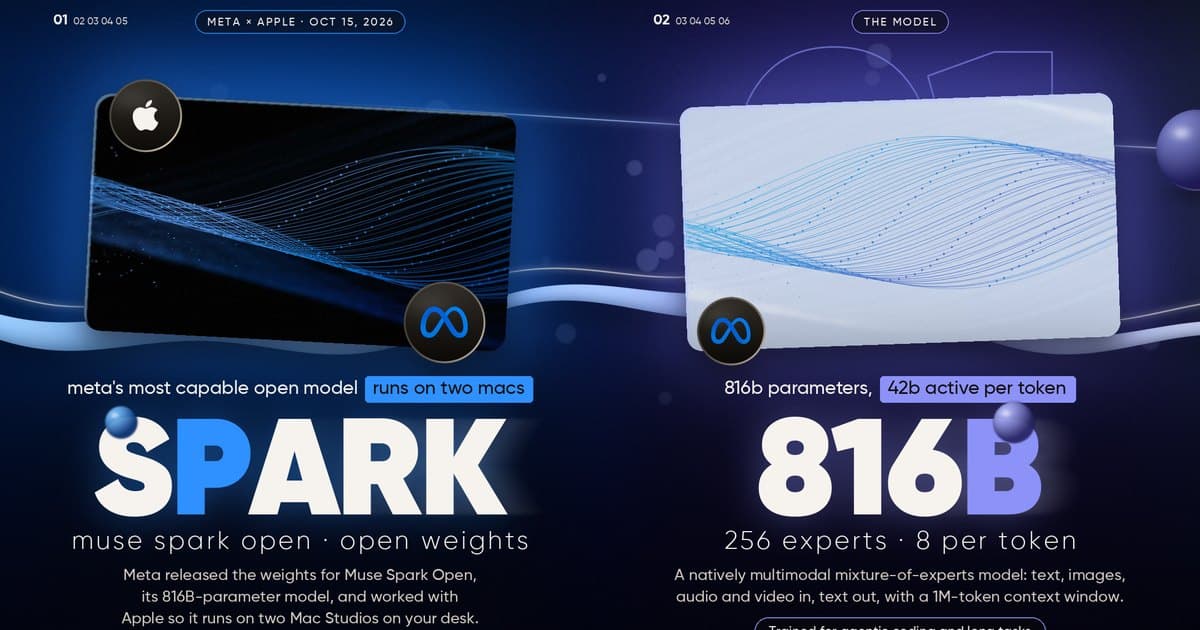
What happened
On October 15, 2026, Meta Superintelligence Labs published Introducing Muse Spark Open and released the model's weights. Meta calls it "the most capable US open-weight model to date": a natively multimodal model with 816B total parameters, 42B active per token and a 1M-token context window, built for coding and agentic work.
The launch was a joint effort with Apple. Meta says Muse Spark Open is "the first model in its class to run on your desktop", using two Apple M5 Ultra Mac Studios and the latest version of Apple's MLX framework. Apple's Machine Learning Research team published its own benchmarks the same day. Axios called it a détente between two long-time rivals.
This page is the long-form briefing behind the BSH Technologies Instagram carousel.
1. The model
- Mixture of experts. According to the Hugging Face launch post, each MoE layer has 256 experts and a router picks 8 per token. The experts hold about 97% of the parameters, so the model needs the memory of an 816B model but computes each token with about 42B.
- Multimodal in, text out. It takes text, images, audio and video as input and generates text. A 1.8B-parameter perception encoder handles images and video frames, and an audio encoder emits one token every 80 ms.
- Long context. The context window is up to 1M tokens, shared by text, image, video and audio tokens.
- Trained for agents. Meta says it plans, acts, observes and self-corrects over long tasks: reading a codebase, writing and debugging code, calling tools and browsing the web with images.
- Reasoning always on. Hugging Face notes reasoning can't be turned off. Effort runs from low to xhigh, and the default is xhigh.
- Checkpoints. BF16 (about 1.5 TB in safetensors) and NVFP4 4-bit, which Meta says has negligible accuracy loss.
2. The hardware: two Mac Studios, one terabyte
- Meta says the M5 Ultra's integrated GPU can use up to 512 GB of unified memory per Mac Studio, so two machines can hold the whole model, and the chip's 1.2 TB/s of memory bandwidth is fast enough to read the small slice each token needs. In Meta's words, "two Mac Studios behave like one supercomputer with a terabyte of unified memory."
- Meta's Mac setup guide lists the requirements: two M5 Ultra Mac Studios with 512 GB each, or four with 256 GB each; macOS 26.2 or later; MLX 0.30.1 or later; and a direct Thunderbolt 5 link between every pair of Macs, ideally with two cables per pair.
- The Macs exchange intermediate results over RDMA on Thunderbolt 5 through MLX's
jacclbackend. In NVFP4 the weights take about 493 GB, which with working memory is too much for any single Mac, Apple says. - Cost and timing: Apple's Mac Studio announcement put the M5 Ultra model at up to 512 GB of memory. MacRumors reports the 512 GB configuration hasn't shipped yet and is due later this month, and that the 256 GB model already costs more than $10,000.
3. The speed
Apple's MLX team measured decode speed at an 8,192-token context:
- 15.7 tokens/s on two Mac Studios with pipeline parallelism.
- 25.0 tokens/s on two Mac Studios with tensor parallelism.
- 36.7 tokens/s on four Mac Studios with tensor parallelism, which Apple describes as well above average human reading speed.
- Time to first token at 8K context fell from 8.4 s (two Macs, pipeline) to 4.8 s on four Macs. On models that fit on one machine, Apple says M5 Ultra gives up to 4.6x faster time to first token and about 1.6x faster generation than M3 Ultra.
- Apple also measured peak power of about 300 W for an M5 Ultra Mac Studio during inference.
4. The benchmarks, read carefully
- On Meta's own scorecard, Muse Spark Open leads its comparison table on MCP-Atlas (89.2), JobBench (61.8) and HLE-Diamond (26.1), against open models including Nemotron 3 Ultra, Beam, Mistral Large 4, Qwen3.8, GLM 5.3 and Kimi K3.
- It does not lead everywhere. On coding it scores 76.4 on Terminal-Bench 2.1 and 60 on DeepSWE 1.1, behind Kimi K3 (85.0 and 68) and GLM 5.3 (83.9 and 67). On GDPval-AA v2, GLM 5.3, Qwen3.8, Kimi K3 and Mistral Large 4 all score higher.
- These are Meta's numbers. Meta says details are in its evaluation methodology report and model card, with a full evaluation report "available soon". Wait for independent tests before treating the scores as settled.
5. Where to get it and what the license allows
- Weights: Hugging Face, Amazon SageMaker AI, Google Cloud Model Garden and Microsoft Foundry Models.
- Hosted APIs: Baseten, Fireworks AI, Groq, Modal, Nebius, OpenRouter and Together AI.
- Runtimes: SGLang, vLLM, TensorRT-LLM, Hugging Face Transformers, Apple MLX, llama.cpp and Unsloth, with optimisations for AMD, Apple, Intel and NVIDIA silicon. Meta also ships auto-tuned Helion GPU kernels in SGLang.
- License: the Muse Model License with "limited commercial terms", which Meta says allow many developers to use the model for free. Read the terms before you build a product on it.
- Safety: Meta says the open model got extra safety post-training and met the thresholds of its Meta Superintelligence Scaling Framework for release.
6. Why Apple and Meta teamed up
- Axios reports the companies worked together for several months, and Meta AI chief Alexandr Wang credited former Apple executive Daniel Gross, now at Meta, with bringing the two sides together.
- Meta gets its model in front of more developers. Apple gets a showcase for its most powerful desktop.
- Because the model runs locally, Meta doesn't receive users' prompts, sidestepping the privacy fight that has long divided the two companies. "Meta has no control or visibility to any of that," Wang told Axios.
- This is not Meta's model inside Apple Intelligence. Axios notes that would be a much bigger step.
Why it matters
- Frontier-class models are reaching the desk. A model this size used to need a GPU cluster. Now it fits on two desktop computers, for teams that can afford them.
- Private by default. Running locally means code, documents and prompts never leave your network, which matters in regulated work.
- More choice beyond GPUs and closed APIs. Axios notes that local, open models give companies more alternatives to Nvidia GPUs and proprietary models.
What teams can do now
- Try it hosted first. Test your own coding and agent tasks through one of the API partners before you buy hardware.
- Size the hardware honestly. Two 512 GB M5 Ultra Mac Studios, or four 256 GB ones, plus Thunderbolt 5 cabling. On NVIDIA, the NVFP4 checkpoint runs on a single B200 node, says Hugging Face.
- Check the license. "Limited commercial terms" is not the same as a permissive open-source license.
- Benchmark on your work. Its agentic scores are strong, but rivals beat it on Meta's own coding benchmarks.
Primary sources
- Meta AI Research: Introducing Muse Spark Open, The Most Capable US Open-Weight Model to Date (Oct 15, 2026)
- Hugging Face: Welcome Muse Spark Open (Oct 15, 2026)
- Apple Machine Learning Research: Local and Distributed Large LLM Inference with MLX and RDMA on Mac Studio (Oct 15, 2026)
- Meta Model API docs: Muse Spark Open on Mac
- Hugging Face: Muse Spark Open model collection
- Axios: Apple and Meta bury the hatchet, for AI (Oct 15, 2026)
- MacRumors: Meta and Apple Bring Muse Spark Open AI Model to Mac Studio (Oct 15, 2026)
- Apple Newsroom: Apple introduces new Mac Studio with M5 Max and M5 Ultra (Aug 25, 2026)
How BSH can help
At BSH Technologies we help teams decide when to run AI models locally and when to use hosted APIs: hardware sizing, private on-premise deployments, agentic coding setups and evaluations on your own tasks. If you want frontier-class AI without sending your code or data to a third party, our Thrissur engineers can help you plan and build it.
Frequently asked questions
What is Meta Muse Spark Open?
Muse Spark Open is an open-weight model Meta released on October 15, 2026. It is a natively multimodal mixture-of-experts model with 816B total parameters, about 42B active per token and a 1M-token context window, built for coding and agentic work. Meta calls it the most capable US open-weight model to date.
Can Muse Spark Open run on a Mac?
Yes, but not on one. Meta and Apple say it runs on two Mac Studios with M5 Ultra and 512 GB of unified memory each, or four with 256 GB each, linked by Thunderbolt 5 and running Apple's MLX framework on macOS 26.2 or later.
How fast is Muse Spark Open on Mac Studio?
Apple's MLX team measured 15.7 tokens per second on two Mac Studios with pipeline parallelism, 25.0 with tensor parallelism, and 36.7 tokens per second on four Mac Studios, at an 8,192-token context.
Is Muse Spark Open free for commercial use?
It is free to download under the Muse Model License, which has limited commercial terms that Meta says allow many developers to use it for free. Check the license terms before building a commercial product on it.
From the blog
View all posts
Anthropic Scion: Why Claude's Code Outgrew Git, and What Replaced It
Anthropic's merges jumped from about 2,500 a day in May 2026 to more than 30,000 by September, so a seven-person team built Scion, an in-house version control system, and moved its monorepo off git in five months. Here is how Scion works, what it changed and what other engineering teams can learn from it.

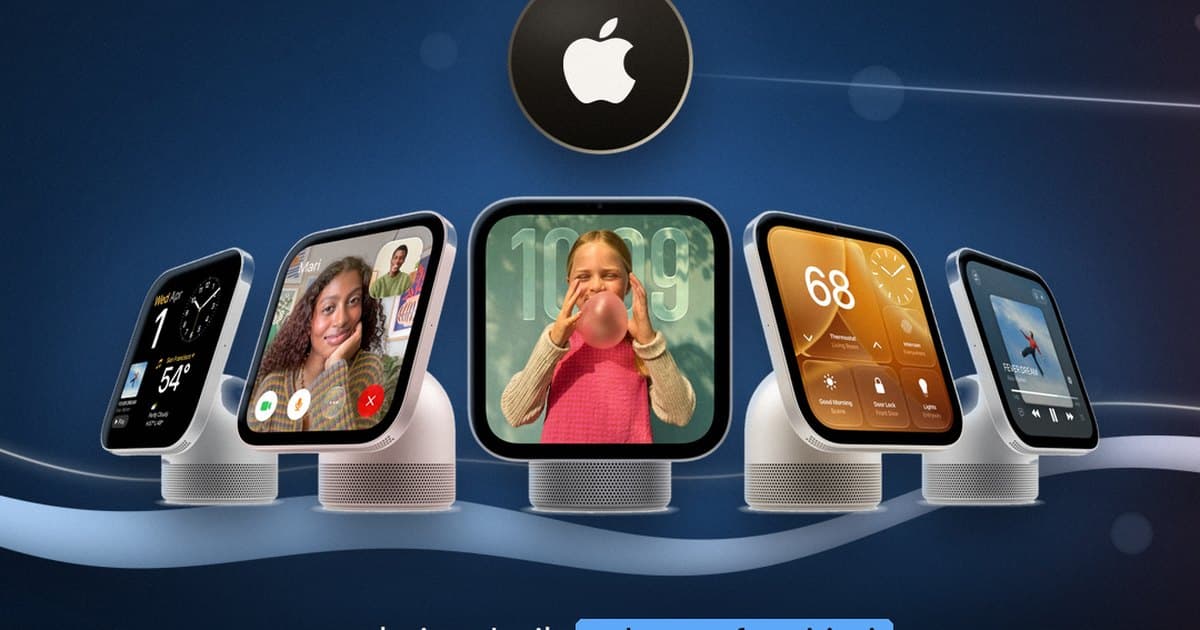
Apple HomeView: A $299 Smart Home Hub Built Around Siri AI
On October 13, 2026 Apple introduced HomeView, a $299 7-inch smart home hub built around the all-new Siri AI. It recognises up to six people by face, keeps camera and mic data in Secure Exclaves on the A18 chip, and ships November 13, though not in the EU. Here is what it does and what it means.