Google's Gemini 4 Carbon: #1 Frontier Model, Built for Cyber Defense, and the Catch
On October 28, 2026, Google announced Gemini 4 Carbon, its strongest model yet. It ranks #1 on the Artificial Analysis Intelligence Index v5.0 at 59, leads SEC-bench Pro (88.2%), ExploitGym (54.8%) and CWE-bench (71.0%), and blocked every attack in Gray Swan's prompt-injection test. For now it goes only to vetted cyber defenders. Here are the benchmarks, the safety numbers, the price and the catch.
What Google announced
On October 28, 2026, Google DeepMind's Koray Kavukcuoglu announced Gemini 4 Carbon, which Google calls "our strongest model with state-of-the-art cybersecurity and long horizon capabilities." It arrives only weeks after Gemini 4 Argon, which also went to cyber defenders first, and Google frames Carbon as proof of how fast it is now moving the frontier. This page is the long-form briefing behind the BSH Technologies Instagram carousel.

- What it is: Google's new top model, tuned for long-horizon coding, agentic work and the full cyber-defense lifecycle: finding, validating and patching vulnerabilities.
- Who gets it first: a subset of cyber defenders starting this week, then more trusted partners through Google DeepMind's Fairwind Program.
- Price when it launches: $2 per million input tokens and $10 per million output tokens (introductory), with cached input 95% off.
Ranked #1 on the Artificial Analysis Intelligence Index
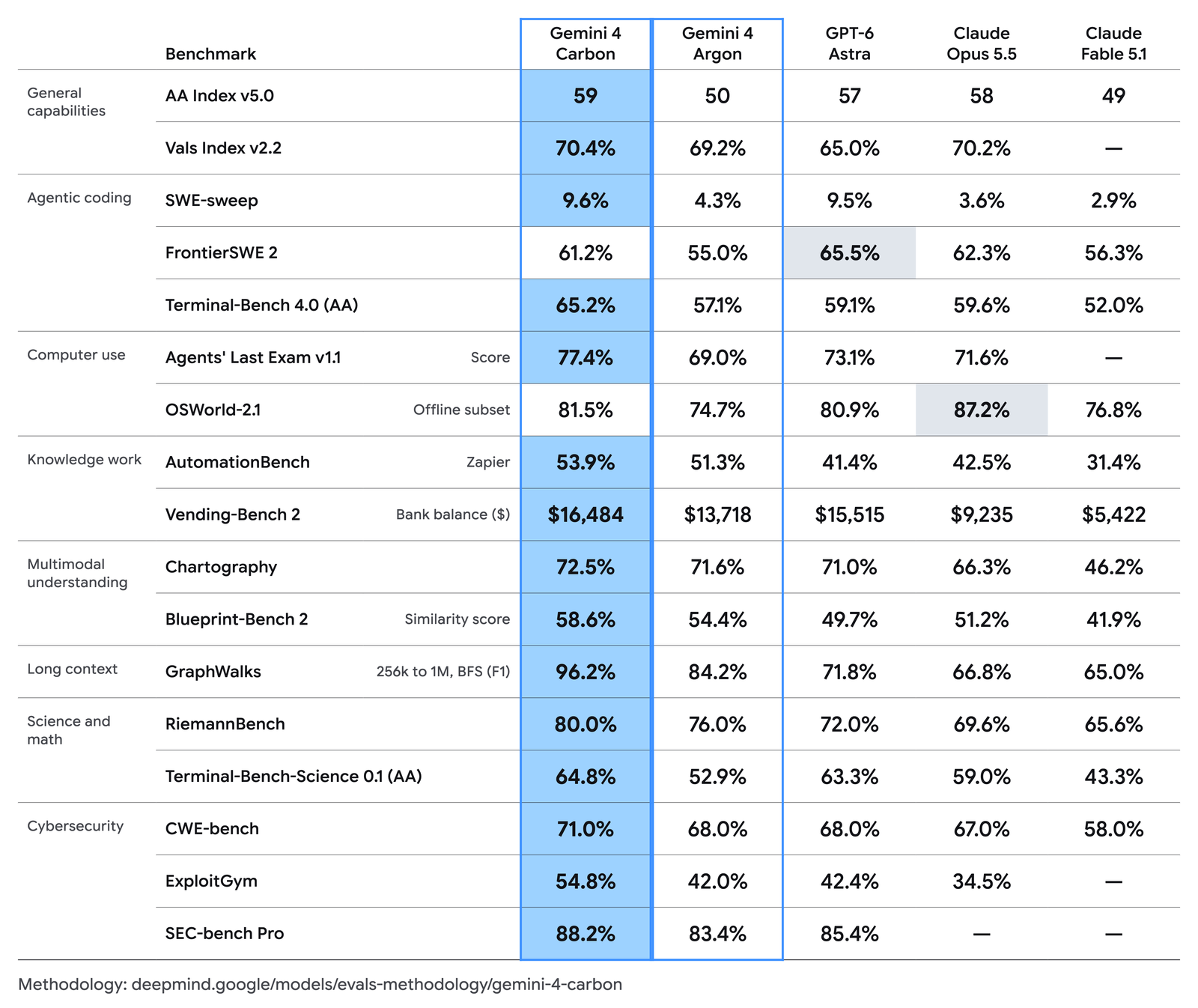
Google says Carbon ranks #1 on v5.0 of the Artificial Analysis Intelligence Index with a score of 59. In Google's own table that puts it one point ahead of Claude Opus 5.5 (58), two ahead of GPT-6 Astra (57) and nine ahead of Gemini 4 Argon (50). Across the 17 benchmarks in the table, Carbon has the top score on 15. The two it does not win are FrontierSWE 2 (GPT-6 Astra leads, 65.5% vs 61.2%) and the OSWorld-2.1 offline subset (Claude Opus 5.5 leads, 87.2% vs 81.5%). Computer use is a crowded race: OpenAI pitched its cheaper GPT-6.1 Terra at exactly that job two days earlier.
Long-horizon coding
- Runs for days: Google says its teams have seen Carbon "run for days to persist through dead ends" on multi-step engineering work, such as root-causing and patching subtle bugs across large codebases and low-level systems.
- Coding scores: Terminal-Bench 4.0 (AA) 65.2% vs Argon's 57.1%, and SWE-sweep 9.6% vs Argon's 4.3%.
- Web development: Carbon gained +89 Elo to reach #4 (1768) on WebDev Arena.
- Long context: 96.2% on GraphWalks (256k to 1M tokens), up from Argon's 84.2%.
Cyber defense: find, validate, patch
Google says Carbon is state of the art across the whole defense lifecycle. All three external results below were evaluated without guardrails.
Finding real vulnerabilities: SEC-bench Pro 88.2%
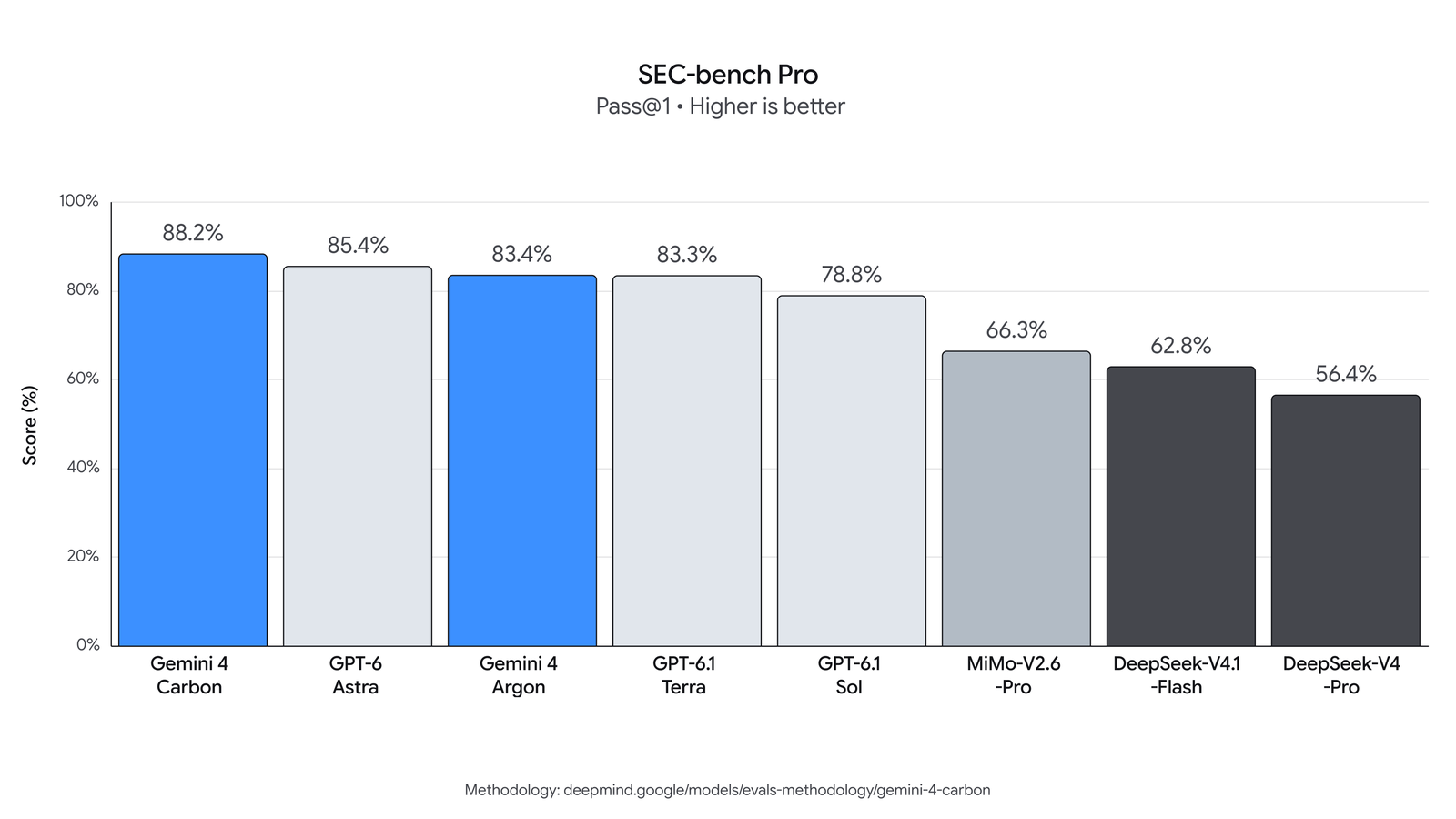
On SEC-bench Pro, which tests whether a model can uncover flaws buried in real-world software, Carbon scores 88.2%, ahead of GPT-6 Astra (85.4%) and Gemini 4 Argon (83.4%).
Validating risk: ExploitGym 54.8%
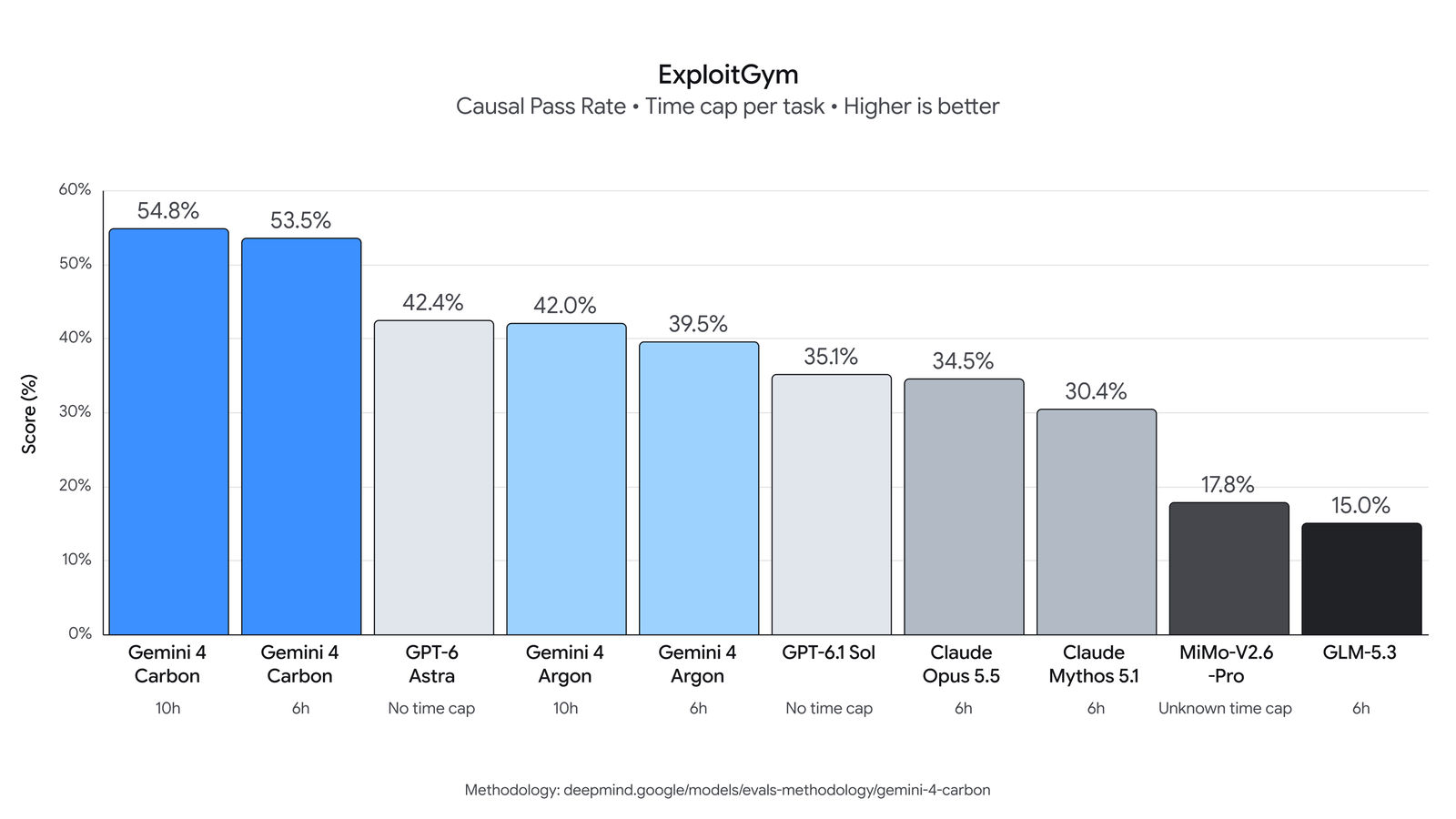
Defenders use models to check which bugs are actually exploitable, so they can fix the dangerous ones first. Carbon sets a new high of 54.8% on ExploitGym, against 42.4% for GPT-6 Astra and 42.0% for Argon.
Patching the root cause: CWE-bench 71.0%
On Collinear's CWE-bench, which checks whether validated findings turn into working code fixes, Carbon reaches 71.0%, three points ahead of Argon and GPT-6 Astra (68.0%).
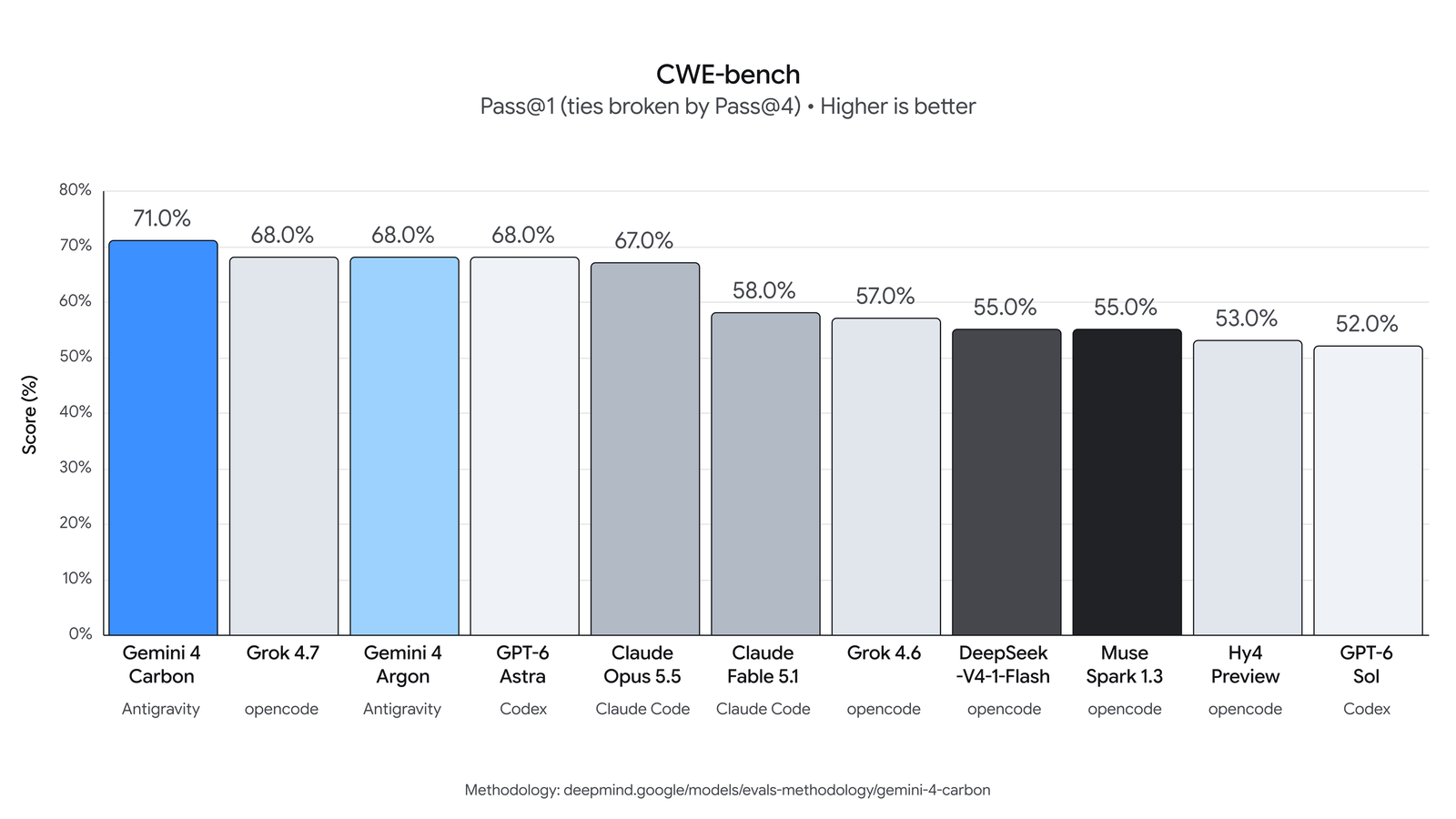
What Google's own teams report
- More than 2x higher success at generating secure code than Argon on internal benchmarks.
- The Chrome team reported Carbon did more than 10x better than "another lab's large frontier model" at generating high-quality patches.
- Wiz sees Carbon leading on web penetration-testing benchmarks used in its Scan for Good initiative.
Safety: zero on Gray Swan, fewer made-up claims
Carbon uses the same layered safety stack as Argon (training, real-time misuse defenses, prompt-injection resilience and chain-of-thought monitoring), described in Google's Gemini 4 Safety and Security report. What Google says changed:
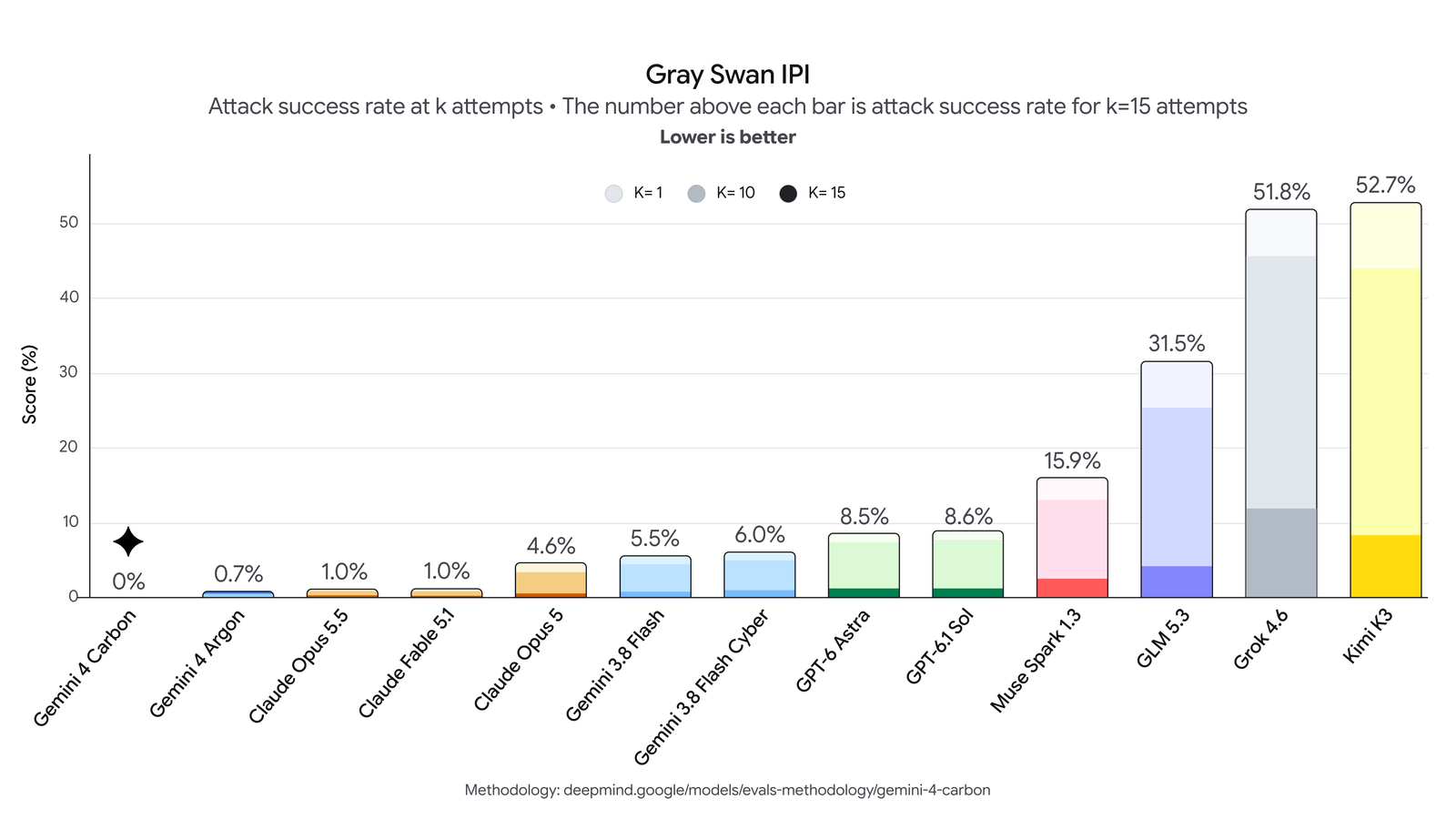
- Prompt injection: on Gray Swan's Indirect Prompt Injection benchmark, Argon let 0.7% of attacks through. Carbon gets 0.0%, resisting every attack Google evaluated.
- Less cheating: successful cheating on Terminal-Bench 4.0 fell to 0.0%, with attempts down to 0.4%.
- Misalignment: in live coding with Google's teams, high-severity misalignment alerts dropped by almost 80%.
- Honesty: about 2x fewer unsupported claims than Argon. Carbon flags caveats or lists what is still missing instead of making things up.
- Scope: overreach fell 26% and under-service fell 29%.
The catch
- You can't use it yet: access starts with a subset of cyber defenders and expands slowly through the Fairwind Program. Google gives no date for developers, businesses or consumers, only "as soon as possible."
- Government testing first: Google says it is taking part in the U.S. government's voluntary pre-release testing process.
- Google's own numbers: every score above comes from Google's launch post, and the cyber benchmarks were run without guardrails. Wait for independent tests.
- The price doubles later: $2 / $10 per million tokens is introductory. After that period it becomes $4 input / $20 output.
Why it matters
Carbon lands in a crowded stretch of frontier releases (see our roundup of 18 AI launches in one month), and the second time Google has put its best model in front of security teams before anyone else. If the find-validate-patch numbers hold up outside Google, defenders get a model that can do real vulnerability work for days at a time, which is also why Google is keeping access tight.
Sources
Frequently asked questions
What is Gemini 4 Carbon?
Gemini 4 Carbon is Google DeepMind's frontier model announced on October 28, 2026. Google calls it its strongest model, with state-of-the-art cybersecurity and long-horizon coding capabilities. It follows Gemini 4 Argon.
How does Gemini 4 Carbon rank on benchmarks?
Google says it ranks #1 on the Artificial Analysis Intelligence Index v5.0 at 59, ahead of Claude Opus 5.5 (58) and GPT-6 Astra (57), and scores 88.2% on SEC-bench Pro, 54.8% on ExploitGym and 71.0% on CWE-bench.
Can I use Gemini 4 Carbon?
Not yet for most people. Google is giving it first to a subset of cyber defenders and then trusted partners through its Fairwind Program, and has not given a date for developers, businesses or consumers.
How much will Gemini 4 Carbon cost?
It will launch at the same introductory price as Argon: $2 per million input tokens and $10 per million output tokens, with cached input 95% off. After the introductory period the price becomes $4 input and $20 output per million tokens.
Is Gemini 4 Carbon safer than Argon?
According to Google, Carbon had a 0.0% attack success rate on Gray Swan's indirect prompt injection benchmark (Argon 0.7%), cut successful cheating on Terminal-Bench 4.0 to 0.0%, reduced high-severity misalignment alerts by almost 80% and made about 2x fewer unsupported claims. These are Google's own results.
From the blog
View all posts
OpenAI's GPT-6.1 Terra: Half the Price, Built for Computer Use, and the Catch
On October 26, 2026, OpenAI launched GPT-6.1 Terra, a fast, efficient model for computer use, visual reasoning and writing. It costs $1 per million input tokens and $5 per million output tokens, 50% less than GPT-5.6 Terra and GPT-6.1 Sol, scores 15 points higher than GPT-5.6 Terra on Agents' Last Exam and runs over 3x faster than GPT-6 Astra and GPT-6.1 Sol. Here is what it does, what it costs, the benchmarks and the catch.

Microsoft's Agensh: 1,024 AI Agents With No Boss Rebuild Real Software, What It Scored, and the Catch
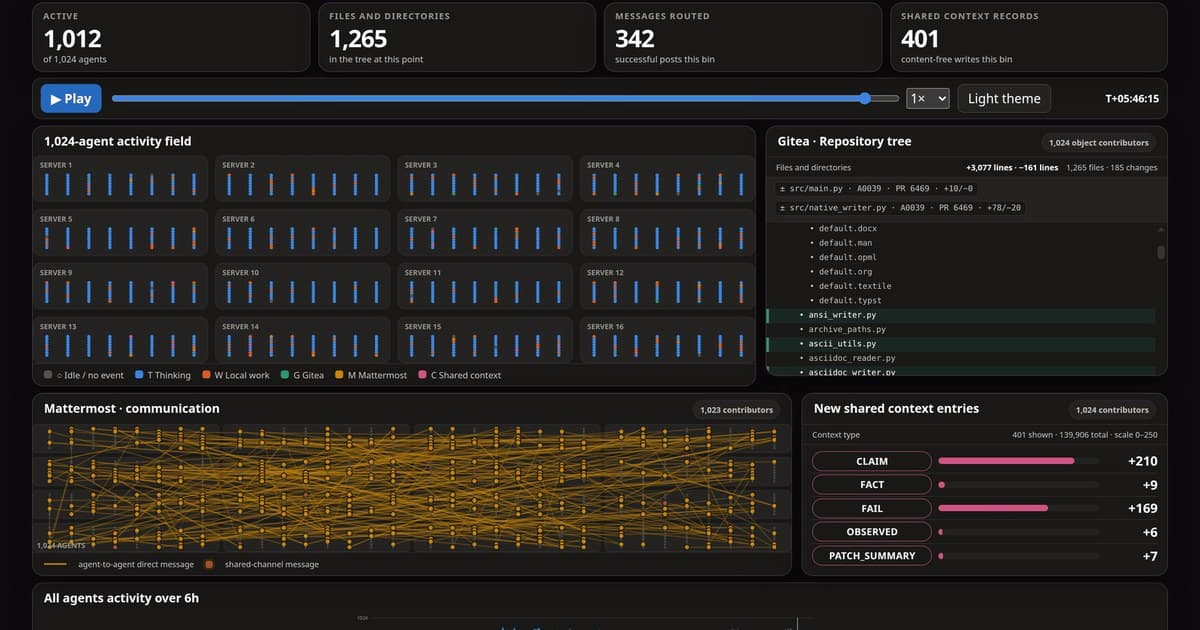
On October 24, 2026, Microsoft Research open-sourced Agensh, a multi-agent harness in which up to 1,024 AI coding agents organise themselves with no central orchestrator. On the hardest ProgramBench tasks the mean pass rate rose from 19.31% with one agent to 28.78% with 128, and Pandoc reached 55.06% with 1,024 agents. Here is how it works, what emerged, and the catch.