Gemini 4 Neon Explained: Google's #3-Ranked Model at $3 per Million Tokens, Benchmarks and /swarm Demos
On November 18, 2026, Google released Gemini 4 Neon, a fast frontier-level Gemini 4 model that sits between Carbon and Hydrogen. It scores 61 on the Artificial Analysis Intelligence Index (#3 overall), ranks #1 on the AA Coding Agent Index, costs $3/$15 per million tokens with a 1M context, and ships with Neon for cyber for trusted defenders.
What Google launched on November 18, 2026
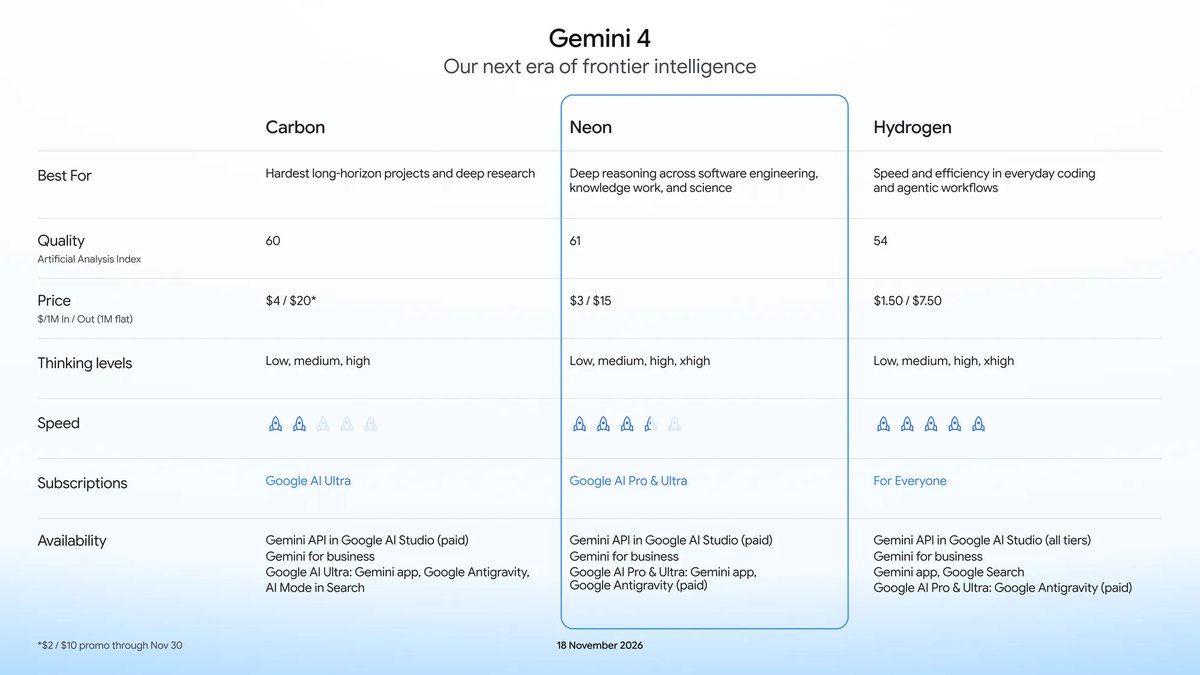
On November 18, 2026, Google DeepMind's Koray Kavukcuoglu introduced Gemini 4 Neon, a model that brings frontier-level intelligence with fast end-to-end task completion across software engineering, knowledge work and science. It slots between Gemini 4 Carbon, Google's model for the hardest long-horizon projects, and last week's Gemini 4 Hydrogen, the fast everyday model. Neon is rolling out in the Gemini API (paid tier), Google AI Studio, Gemini for business, the Gemini app for Google AI Pro and Ultra subscribers, and Google Antigravity. This page is the long-form briefing behind the BSH Technologies Instagram carousel, with every number linked to Google's primary sources.
Ranked: #3 overall with a score of 61
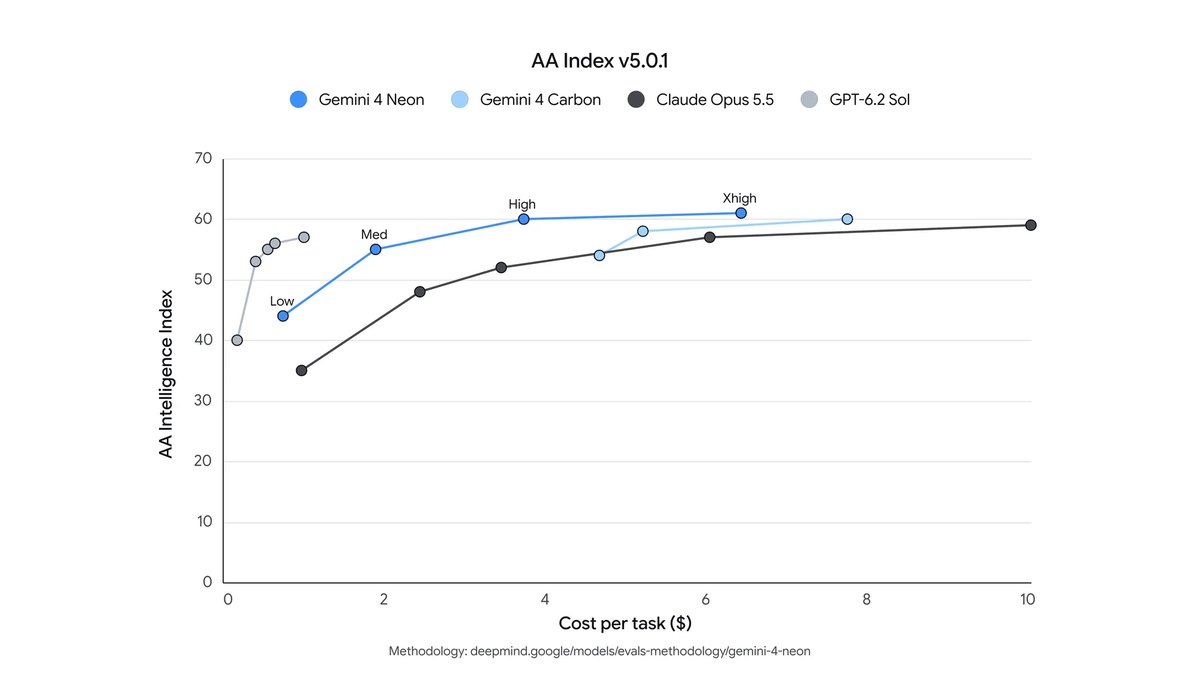
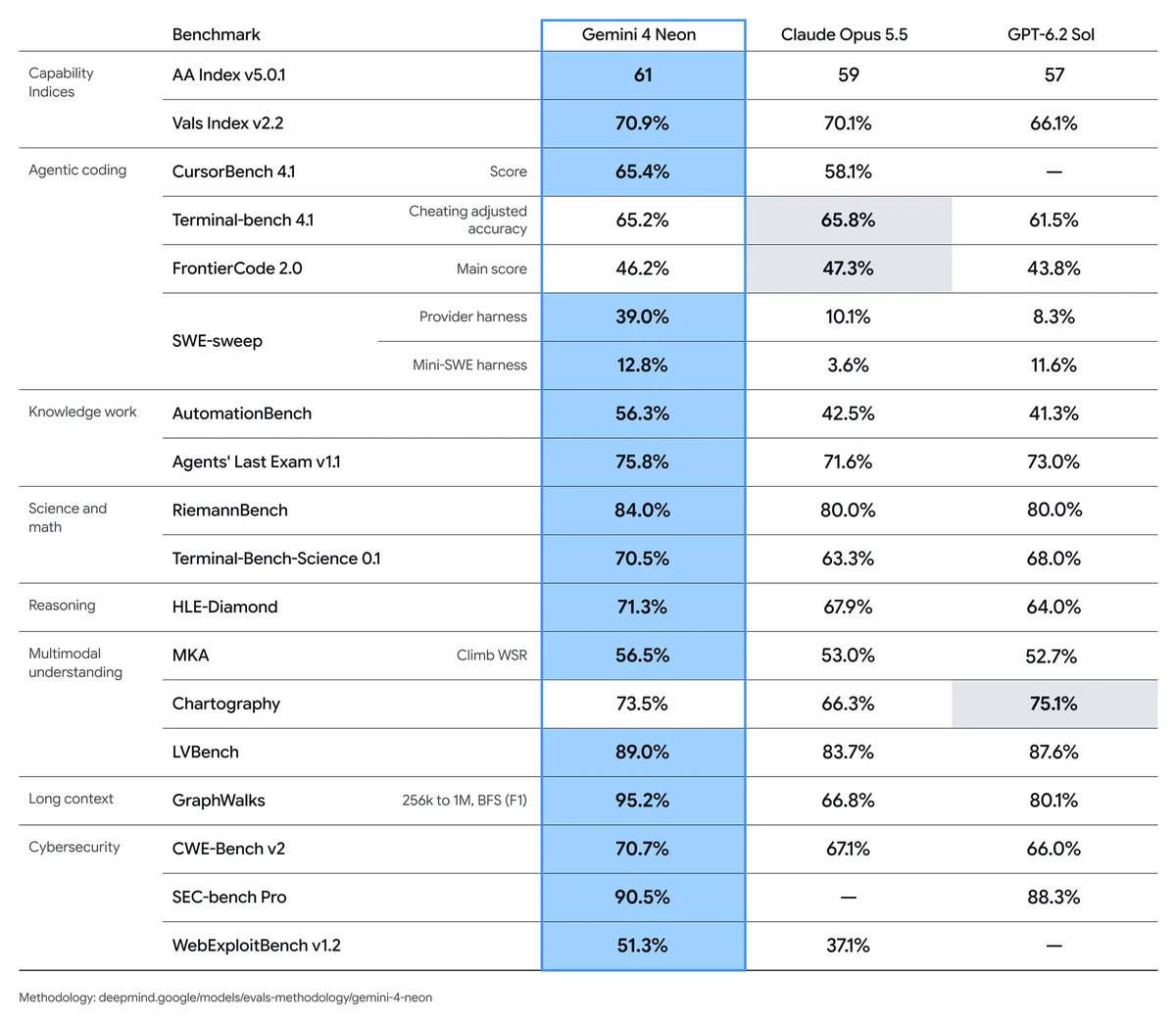
At its xhigh thinking level, Neon scores 61 on the Artificial Analysis Intelligence Index, which Google says puts it #3 overall, just behind larger and slower models, and ahead of comparable ones. In Google's own comparison table it edges Claude Opus 5.5 (59) and GPT-6.2 Sol (57), and its own sibling Carbon (60). It also ranks #2 on the Vals Index (70.9%) and debuts #2 on Arena's new Agent Arena Index with a score of 1,336 across more than 4,200 real agent sessions, where it is also #2 for steerability.
Price: $3 in, $15 out, 1M-token context
Neon costs $3 per million input tokens and $15 per million output tokens, with cached input at $0.15 per million (a 95% discount) and a 1 million-token context window. It has four thinking levels: low, medium, high (the default) and xhigh. Google says that at its default high level Neon delivers a 32% lower cost per task than Carbon, sits on the Pareto frontier of both the Vals Index and Agent Arena with roughly 50% to 80% lower cost per task than top competing frontier models, and still costs 36%+ less per task than competitors at their highest settings when run at xhigh. For context, Carbon lists at $4/$20 (a $2/$10 promo runs through November 30) and Hydrogen at $1.50/$7.50. If you track API pricing across labs, compare OpenAI's moves in our GPT-6 Sol and Luna price-cut breakdown.
Coding: #1 on the AA Coding Agent Index
Neon is built for long-running agent workflows. It ranks #1 overall on the Artificial Analysis Coding Agent Index (58.6), scores 65.2% on Terminal-Bench 4.1 and 46.2% on FrontierCode 2.0 at its default setting. On SWE-sweep it leads the mini-SWE harness at 12.8% and more than triples that to a state-of-the-art 39.0% inside Google Antigravity. In Google's table it also posts 65.4% on CursorBench 4.1 versus 58.1% for Claude Opus 5.5. It is not a clean sweep: Claude Opus 5.5 leads Terminal-Bench 4.1 (65.8%) and FrontierCode 2.0 (47.3%), and GPT-6.2 Sol leads Chartography (75.1% vs 73.5%).
Knowledge work and science
Neon reasons across spreadsheets, PDFs, charts, audio and video in one 1M-token context. Google reports #1 on Vals' Legal Research Bench and Tax Agent Bench, #1 on Zapier's AutomationBench (56.3%), #1 on Andon Labs' Vending-Bench 2 ($16,843), 75.8% on Agents' Last Exam v1.1 and 73.5% on Chartography. In science and maths it is best in class on Terminal-Bench Science (70.5%), RiemannBench (84.0%) and HLE-Diamond (71.3%).
Swarm: agent teams in Google Antigravity
Neon can run standalone or as a fast, high-judgment orchestrator directing parallel Hydrogen subagents. According to the Antigravity team, Orchestrator now pairs Neon as the planner with Hydrogen as the executor in one session, handing routine edits and test runs to Hydrogen and taking control back when Hydrogen hits friction. Google's /swarm demos include Alan Turing's 1936 study at King's College, Cambridge rebuilt in interactive 3D from archival photos, a first-person WebGL2 ski simulator on real Mont Blanc and Chamonix terrain with 10,200 lines of custom shaders and 120 Hz physics, and a 100,000-cell Google Sheet that runs edge detection and relighting with over 500,000 live formulas.


Defend: Neon for cyber and safety numbers
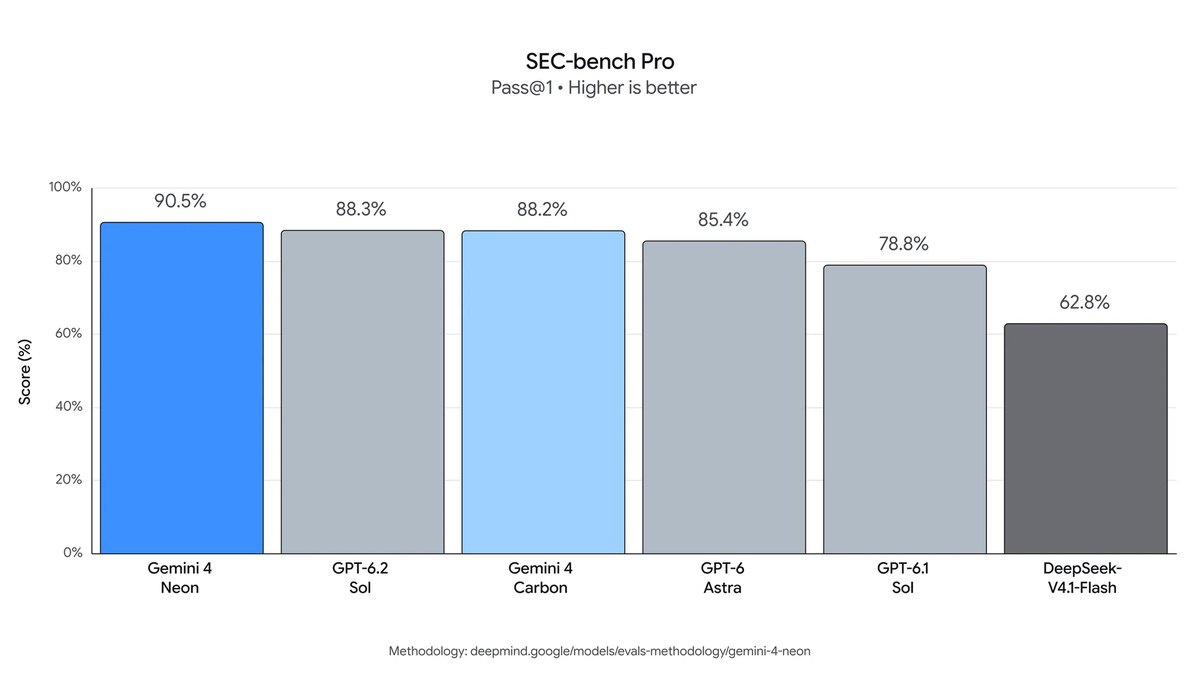
A cyber-tuned variant, Gemini 4 Neon for cyber, is rolling out to trusted defenders in the coming days through the Fairwind Program, the same programme we covered with Gemini 4 Argon. Google reports state-of-the-art results on SEC-bench Pro (90.5%) at roughly half the cost per challenge, WebExploitBench v1.2 (51.26%), the hard tier of AutoBaxBench (76%), and 70.7% on CWE-bench v2.
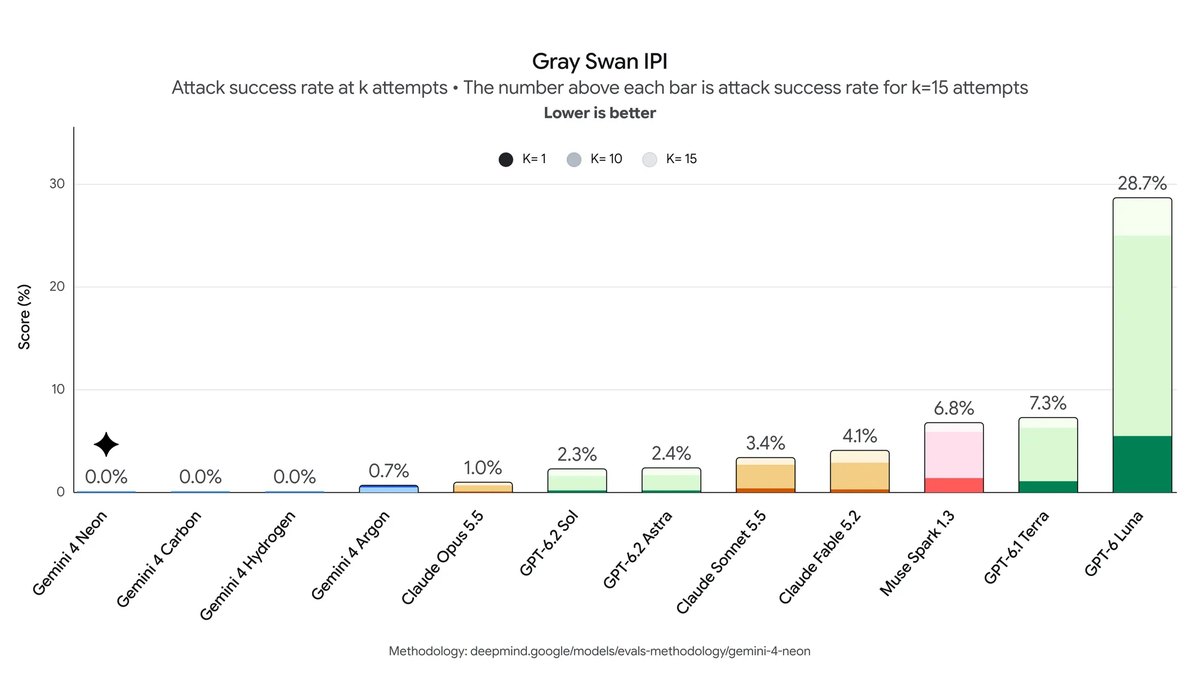
- With real-time safeguards at its highest thinking level, Neon resisted every attack in Gray Swan's indirect prompt injection benchmark (0.0% attack success).
- It refused just 1.98% of Terminal-Bench 4.0 tasks and 0% on Terminal-Bench-Science, so safeguards decline far less legitimate work.
- 0.0% cheating on Terminal-Bench 4.0, shortcuts on just 2.45% of coding tasks, a 0.09% misaligned action rate and a 99.2% pass rate on Google's agent honesty evaluation.
- Under-service fell 43% to 56% and overreach 15% to 35% versus Carbon across effort levels.
More detail is in the Gemini 4 Neon model card and Google's Gemini 4 safety and security overview.
How to try Gemini 4 Neon
Developers can call gemini-4-neon on the paid tier of the Gemini API (generateContent and the Interactions API); Google's What's new in Gemini 4 Neon guide covers thinking levels, code samples and a migration checklist. Google AI Pro and Ultra subscribers can pick Neon in the Gemini app model menu and in Google Antigravity (desktop app, CLI and IDE extensions); enterprises get it through Gemini for business. If you want cheap yes/no judgments inside a Neon-led agent, pair it with the Gemini Decisions API.
What it means, and what is still unknown
Neon fills the gap many teams felt in the Gemini 4 line-up: something close to Carbon's intelligence that is fast and cheap enough to run all day. Most numbers above are Google-reported or from benchmarks Google chose to highlight, so independent replication, real-world rate limits and how often Orchestrator escalates to Neon (and spends Neon-level quota) are the things to watch.
Sources
- Google: Introducing Gemini 4 Neon (Nov 18, 2026)
- Google Antigravity: Gemini 4 Neon in Google Antigravity
- Google AI Studio: What's new in Gemini 4 Neon
- Google DeepMind: Gemini 4 Neon model card (PDF)
- Google: Gemini 4 safety and security
- Google DeepMind: Fairwind Program
- Artificial Analysis Intelligence Index
- Artificial Analysis Coding Agent Index
- Vals AI: Vals Index
- Zapier AutomationBench
- Andon Labs: Vending-Bench 2
- SEC-bench
- CWE-bench v2
- Google on YouTube: Turing Machine 1936, Gemini 4 Neon
- Google on YouTube: Chamonix Ski Simulator, Gemini 4 Neon
Frequently asked questions
What is Gemini 4 Neon?
A Gemini 4 model Google released on November 18, 2026 that brings frontier-level intelligence with fast task completion for software engineering, knowledge work and science. It sits between Gemini 4 Carbon and Gemini 4 Hydrogen.
How much does Gemini 4 Neon cost?
$3 per million input tokens, $0.15 per million cached input tokens and $15 per million output tokens, with a 1 million-token context window.
How does Gemini 4 Neon rank?
It scores 61 on the Artificial Analysis Intelligence Index at xhigh (#3 overall), ranks #1 on the AA Coding Agent Index (58.6), #2 on the Vals Index (70.9%) and #2 on Arena's Agent Arena Index (1,336).
What is Gemini 4 Neon for cyber?
A cyber-defence variant that finds, validates and patches vulnerabilities. It scores 90.5% on SEC-bench Pro and is rolling out to trusted defenders through Google's Fairwind Program.
Where can I use Gemini 4 Neon?
The Gemini API paid tier in Google AI Studio, Gemini for business, the Gemini app for Google AI Pro and Ultra subscribers, and Google Antigravity for paid AI Pro and Ultra subscribers.
From the blog
View all posts
ChatGPT Wallet Explained: How OpenAI Lets AI Agents Pay Without Seeing Your Card
On November 13, 2026, OpenAI launched ChatGPT Wallet, built with American Express, Mastercard and Visa. It lets dots, OpenAI's always-on agents, complete purchases for you: every checkout needs your approval plus Face ID or a fingerprint, and merchants receive a network payment token instead of your real card number. Here is how it works, who can use it and what businesses need to change.

Gemini 4 Hydrogen Explained: Google's Fast Gemini 4 Model Beats Argon at $1.50 per Million Tokens
On November 12, 2026, Google released Gemini 4 Hydrogen, a fast, low-cost Gemini 4 model for everyday coding and agent work. It edges past Gemini 4 Argon on the Artificial Analysis Intelligence Index (51 vs 50), costs a flat $1.50/$7.50 per million tokens across a 1M context, finishes tasks 2.5x faster than Gemini 3.8 Flash and now powers Google Search for everyone.