Gemini Decisions API Explained: Gemini Decision 1 Answers 1,000 Questions in One Pass for $0.10 per Million Tokens
On November 11, 2026, Google launched the Gemini Decisions API and its new Gemini Decision 1 model. Instead of writing text, it scores yes/no, multiple-choice and rubric questions against one multimodal input, up to 1,000 at a time, returning calibrated probabilities in 150 to 250 ms at $0.10 per million input tokens with no output-token charges.
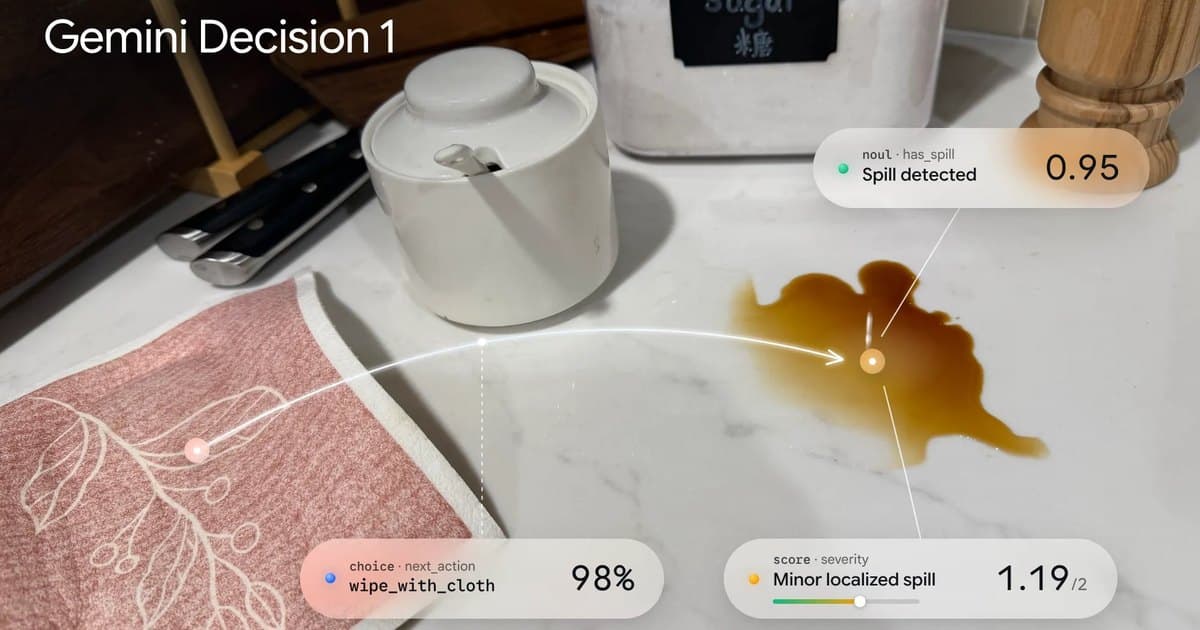
What Google launched on November 11, 2026
On November 11, 2026, Google introduced the Gemini Decisions API, a new Gemini API endpoint for fast, closed-set decisions. It runs on a new model, Gemini Decision 1 (gemini-decision-1), available now through the Gemini API in Google AI Studio. The pitch is simple: when your code needs a judgment to branch on (route this query, flag this upload, pick this tool), generating text and then parsing it is slow and brittle. The Decisions API skips the text entirely and returns calibrated probabilities with a confidence score. This page is the long-form briefing behind the BSH Technologies Instagram carousel, with every number linked to the primary source.
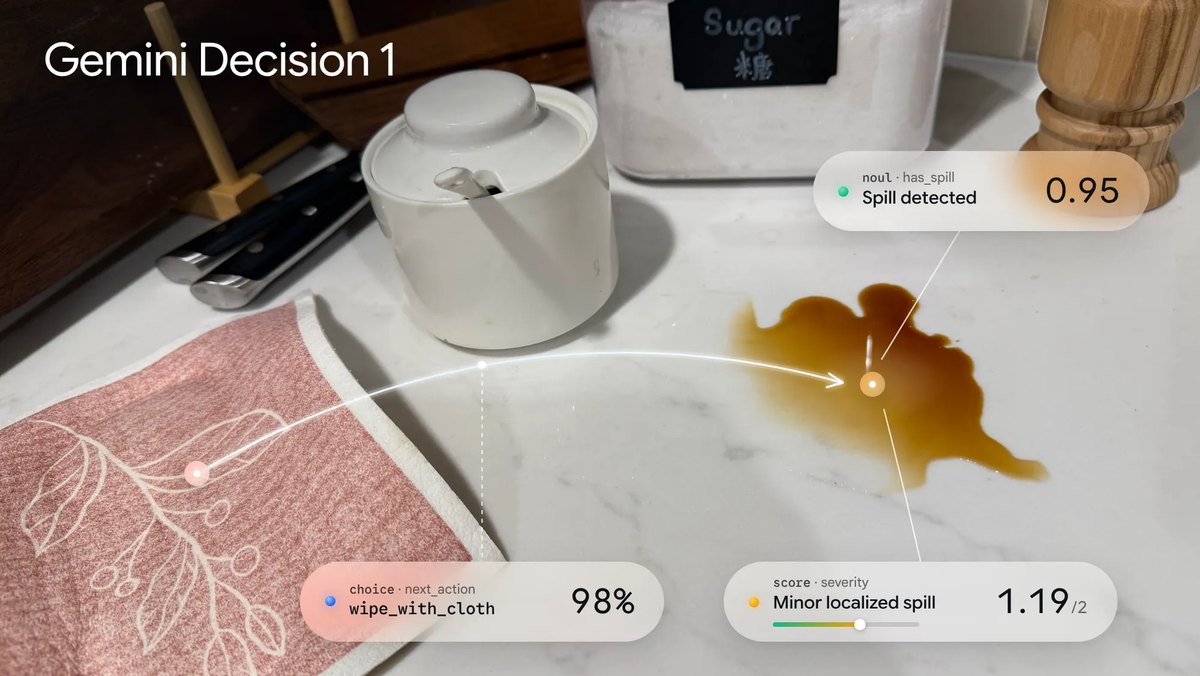
How it works: 1,000 questions, one forward pass
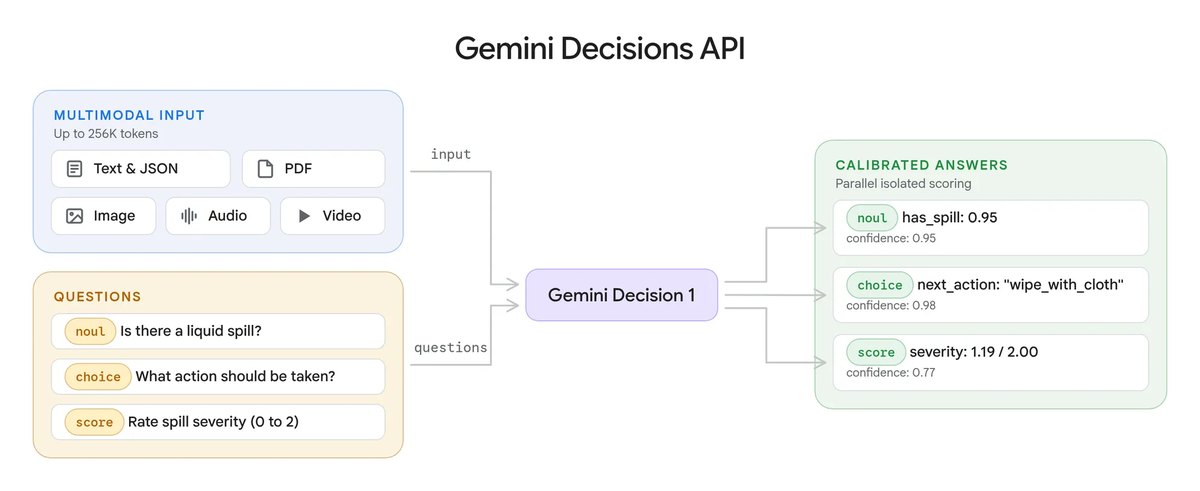
Each request sends one shared input (text, images, audio, video or PDFs, up to 256K tokens) plus a map of up to 1,000 independent questions. Instead of decoding an answer token by token, Gemini Decision 1 scores your candidate options in a single forward pass. According to the Decisions API documentation, questions run in parallel and cannot see each other, so you ask narrow, atomic checks and combine the answers with ordinary if statements in your own code. You can mix modalities in one input, such as a call recording with account metadata, or a scanned claim PDF with damage photos.
The three question types
- noul (yes/no): the probability that a condition holds, bounded between 0.01 and 0.99, with optional true and false descriptions.
- choice: picks one of 2 to 255 options and returns normalised probabilities for every candidate.
- score: grades input against an ordered rubric starting at 0, returning a continuous weighted score and per-level probabilities.
Every answer also carries a confidence score from 0 to 1. Google's advice: act automatically on high-confidence answers and route ambiguous ones to a fallback model or a human reviewer.
Speed: 150 to 250 ms end to end
Because nothing is generated, Google reports a median of 50 to 100 ms of model compute and 150 to 250 ms end-to-end latency across multimodal inputs and contexts up to 16K tokens, staying nearly flat from 1 to 100 questions per request. That makes it usable inside interactive loops (routers, guardrails, UI reactions) where a normal LLM call would add a noticeable pause.
Pricing: $0.10 per million input tokens, $0 output
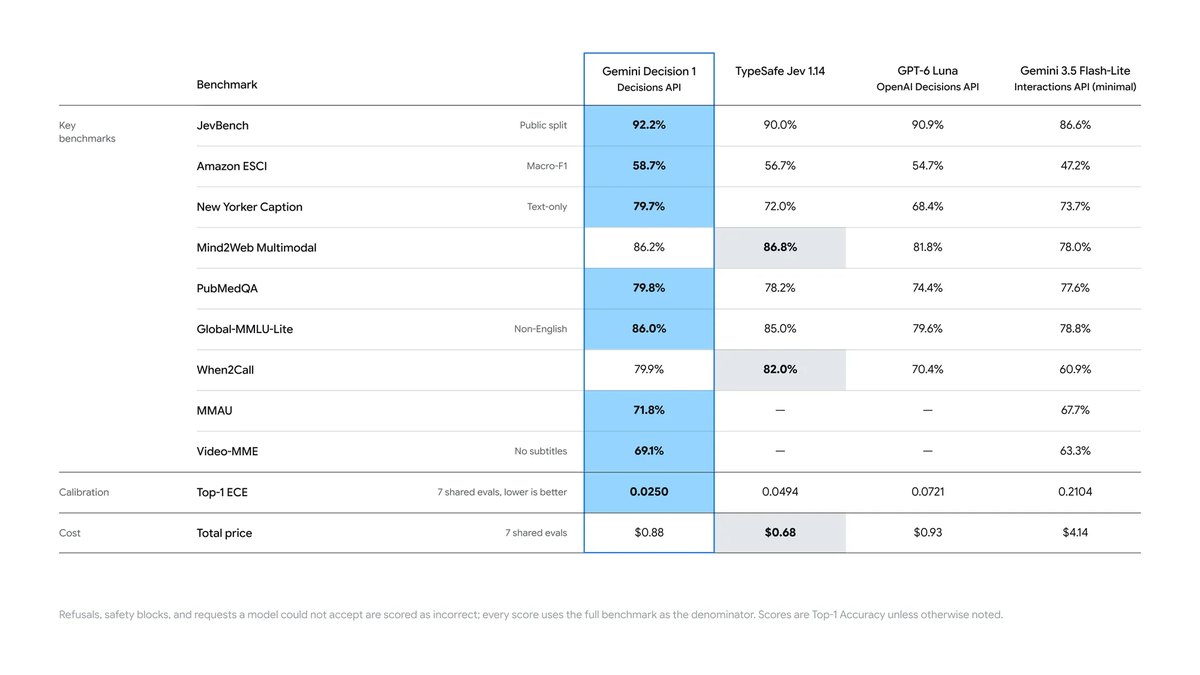
Per Google's Gemini API pricing, Gemini Decision 1 costs $0.10 per 1M input tokens and $0 for output tokens, with a no-cost tier for prototyping in AI Studio. The shared input is billed once per request no matter how many questions you ask; each question adds only its own instruction and criteria tokens. There are no thinking-token bills and no separate audio transcription or OCR charges. On Google's shared benchmark suite, that made it nearly 5x cheaper than Gemini 3.5 Flash-Lite on the Interactions API ($0.88 vs $4.14 total).
Benchmarks: leads 7 of 9, lowest calibration error
Google compared Gemini Decision 1 with TypeSafe Jev 1.14, GPT-6 Luna on OpenAI's Decisions API, and Gemini 3.5 Flash-Lite. It posts the top score on 7 of 9 benchmarks, including JevBench (92.2%), PubMedQA (79.8%), Global-MMLU-Lite (86.0%), MMAU (71.8%) and Video-MME (69.1%), and the lowest Top-1 calibration error: 0.025, versus 0.049 for Jev and 0.072 for GPT-6 Luna. It is not a clean sweep: TypeSafe Jev 1.14 wins Mind2Web Multimodal (86.8% vs 86.2%) and When2Call (82.0% vs 79.9%), and is cheaper overall ($0.68 vs $0.88). These are Google's own numbers on tests Google chose; independent results were not available at launch.
Where Google already uses it
- Gemini Notebook routing: classifies each incoming query in milliseconds and sends it to the right model tier and thinking level, serving everyday queries with up to 40% lower latency.
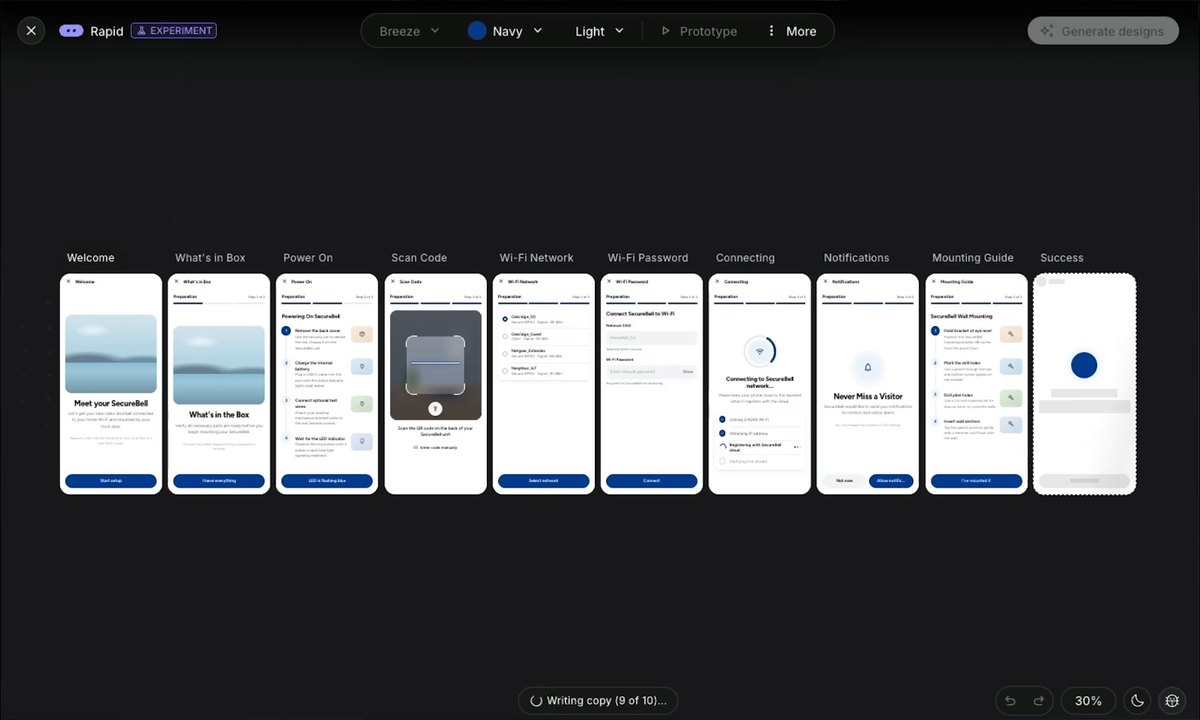
- Stitch Rapid: a new canvas experiment in Stitch that generates playable wireframes of a whole product flow in seconds and applies voice or tap edits almost instantly.
- CC from Google Labs: picks the right emoji reaction from 200+ options in a fraction of a second.
- Google Search: a safety layer that detects adversarial behaviour around MCP tools within the latency budget.
Decision models are becoming their own category
Google is not alone. Cloudflare shipped open-weight decision models in October, covered in our Cloudflare Clef breakdown, and OpenAI offers its own Decisions API (Google benchmarked it with GPT-6 Luna, whose pricing we covered in GPT-6 Sol and Luna price cuts). The shared idea: most agent steps are not essays but choices, and choices should be cheap, fast and calibrated. Decision 1 fits neatly under Google's bigger models too; see our Gemini 4 Carbon breakdown for the frontier end of the same family, and our Gemini Robotics 2.5 explainer for this week's other DeepMind launch.
How to try it
Grab an API key in Google AI Studio, update to google-genai SDK 3.2 or later, and call client.decisions.create(model="gemini-decision-1", input=..., questions=...). Google's launch post links Python, JavaScript and REST guides plus three demo apps (Doorstep Parcels, Speed Sketch and Find the Zoo Keeper). Integrations are rolling out across OpenRouter, LangChain, Vercel, LiteLLM, Pydantic AI, Pipecat, LiveKit and OpenCode, with Gemini in Google Cloud support coming soon. Google's Philipp Schmid has a hands-on walkthrough on DEV Community.
What it means, and what is still unknown
For teams building agents, the Decisions API turns the many small yes/no and routing calls inside a workflow into a cheap, fast, typed primitive with a built-in confidence signal for escalation. What it is not: a generator. It cannot explain itself or write a reply, and it only answers the closed set of options you define. Open questions include independent benchmark results, how calibration holds on your own data, rate limits at scale, and when Google Cloud (Vertex AI) support lands.
Sources
- Google: Gemini Decisions API, fast calibrated multimodal decisions (Nov 11, 2026)
- Gemini API docs: Decisions API
- Gemini API docs: Gemini Decision 1 model
- Gemini API pricing
- Google AI Studio
- Google Stitch
- OpenRouter: google/gemini-decision-1
- OpenAI API docs: Decisions
- DEV Community: Fast multimodal control flow with the Gemini Decisions API
Frequently asked questions
What is the Gemini Decisions API?
A Gemini API endpoint launched by Google on November 11, 2026 for fast, closed-set decisions. It evaluates yes/no, multiple-choice and rubric questions against one multimodal input and returns calibrated probabilities with confidence scores instead of generated text.
What is Gemini Decision 1?
Gemini Decision 1 (gemini-decision-1) is the new model behind the Decisions API. It scores candidate options in a single forward pass rather than decoding text token by token.
How much does Gemini Decision 1 cost?
$0.10 per million input tokens and $0 for output tokens, with a no-cost tier for prototyping in Google AI Studio. The shared input is billed once per request regardless of how many questions you ask.
How fast is the Gemini Decisions API?
Google reports 50 to 100 ms median model compute and 150 to 250 ms end to end, nearly flat from 1 to 100 questions per request.
How many questions can one request contain?
Up to 1,000 independent questions against a shared input of up to 256K tokens across text, images, audio, video and PDFs.
From the blog
View all posts
Gemini Robotics 2.5 Explained: Google DeepMind's Most Dexterous Robot Model, Apollo 2 at Mercedes-Benz and the Safety Numbers
On November 10, 2026, Google DeepMind introduced Gemini Robotics 2.5, its most capable vision-language-action model. Tested on 200+ tasks it scores 30% to 100% higher success than Gemini Robotics 2 and finishes 20% to 30% faster, helped Apptronik's Apollo 2 humanoid kit parts with a 96% success rate on Mercedes-Benz lines, and completes tasks safely 43% more often around people.

Claude Fable 5.2 and Mythos 5.2: Anthropic's Faster, Cheaper Frontier Models Explained (Benchmarks, Pricing, What They Built)
On November 9, 2026, Anthropic released Claude Fable 5.2 to everyone and Claude Mythos 5.2 to verified cyber and life-science teams. Same model, two gates: up to 30% faster, 20% cheaper at $8/$40 per million tokens, 49.1% on FrontierCode 2.0, three working electronic devices, Fermat's Last Theorem formalized in 30 hours and RoboDojo robotics up from 27.6% to 64.9%.