Gemini 4 Hydrogen Explained: Google's Fast Gemini 4 Model Beats Argon at $1.50 per Million Tokens
On November 12, 2026, Google released Gemini 4 Hydrogen, a fast, low-cost Gemini 4 model for everyday coding and agent work. It edges past Gemini 4 Argon on the Artificial Analysis Intelligence Index (51 vs 50), costs a flat $1.50/$7.50 per million tokens across a 1M context, finishes tasks 2.5x faster than Gemini 3.8 Flash and now powers Google Search for everyone.
What Google launched on November 12, 2026
On November 12, 2026, Google DeepMind's Koray Kavukcuoglu introduced Gemini 4 Hydrogen, a fast and efficient member of the Gemini 4 family built for everyday coding and agentic workflows. Where Gemini 4 Carbon and Gemini 4 Argon handle deep, long-horizon reasoning, Hydrogen is the execution model: write the code, run the tests, verify the change. It replaces Gemini 3.8 Flash as Google's high-volume workhorse and is rolling out the same day across Google AI Studio, the Gemini API, Gemini for business, the Gemini app, Google Search and Google Antigravity. This page is the long-form briefing behind the BSH Technologies Instagram carousel, with every number linked to Google's primary sources.
Smarter: 51 vs 50 against Gemini 4 Argon
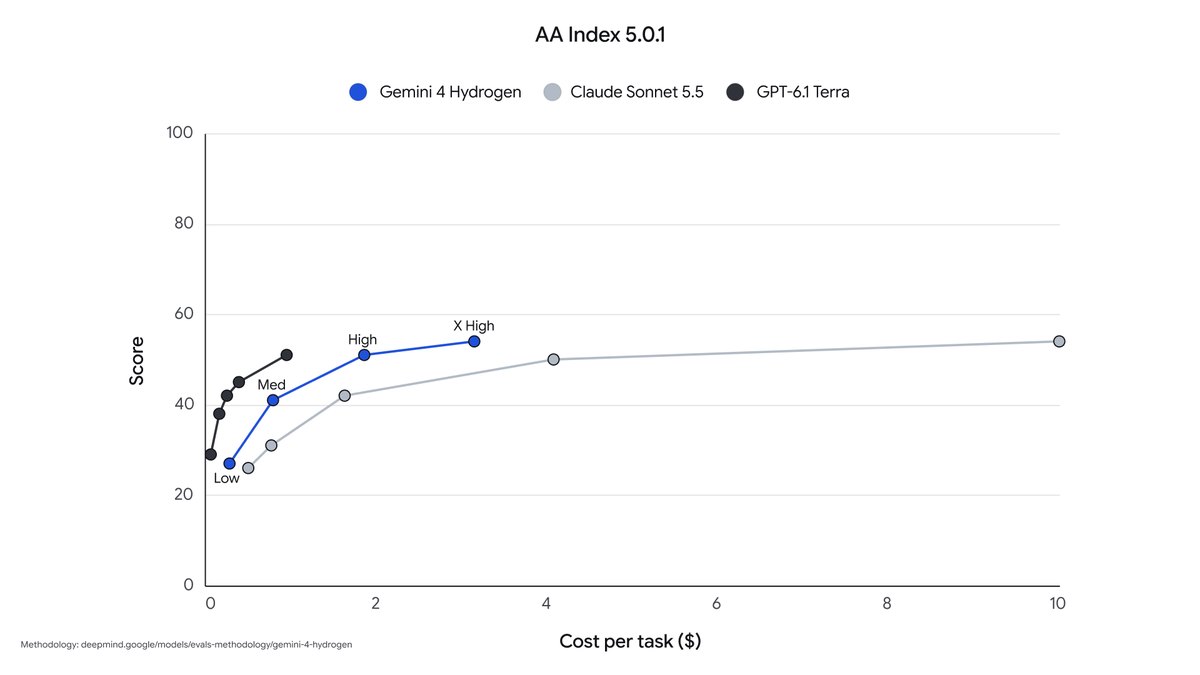
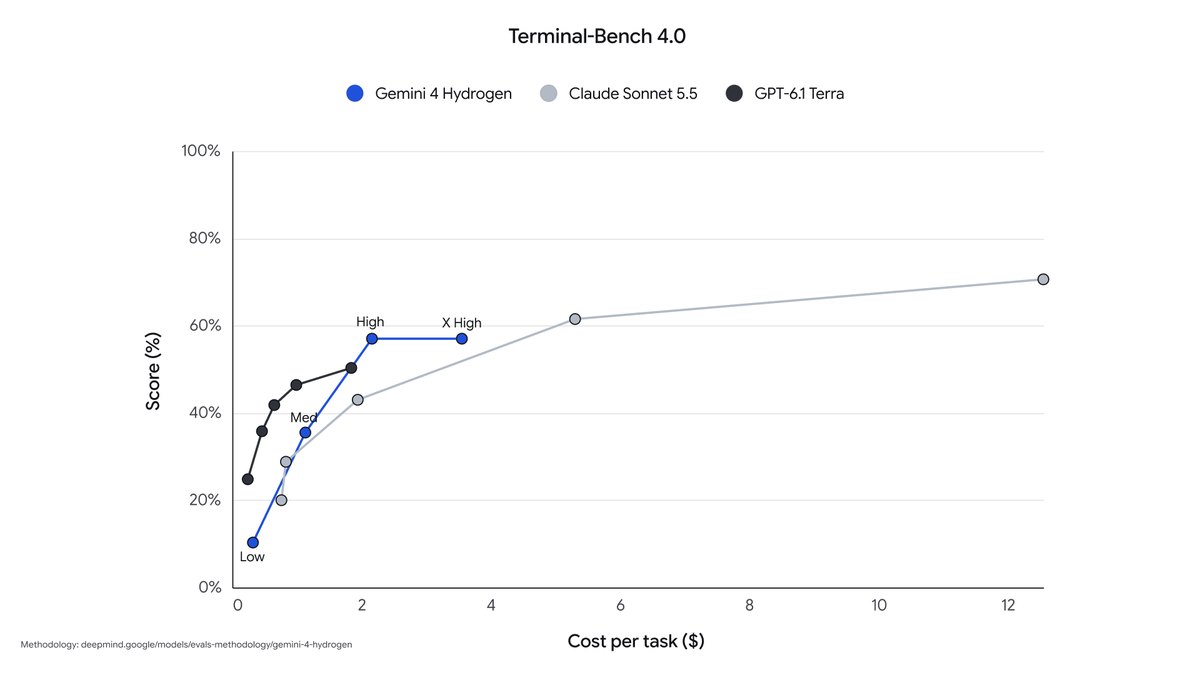
Google says Hydrogen surpasses Gemini 4 Argon on the Artificial Analysis Intelligence Index at its default high thinking level (51 vs 50), reaching 54 at the new xhigh level. Its four thinking levels (low, medium, high and xhigh) let you pay for only as much reasoning as a task needs. In Google's charts, Hydrogen sits above Claude Sonnet 5.5 at every cost point and trails GPT-6.1 Terra on raw cost per task at the low end.
Cheaper: a flat $1.50 / $7.50 per million tokens
Hydrogen is priced flat across its entire 1 million-token context window at $1.50 per million input tokens and $7.50 per million output tokens, with up to 1 million output tokens for long reports. Early partners running graph, SQL and data-heavy enterprise workflows saw it run 2x to 2.8x faster while using 12% to 23% fewer tokens than Gemini 3.8 Flash, largely because it batches file reads and searches in parallel instead of inspecting files one by one.
Faster: 2.5x quicker than Gemini 3.8 Flash
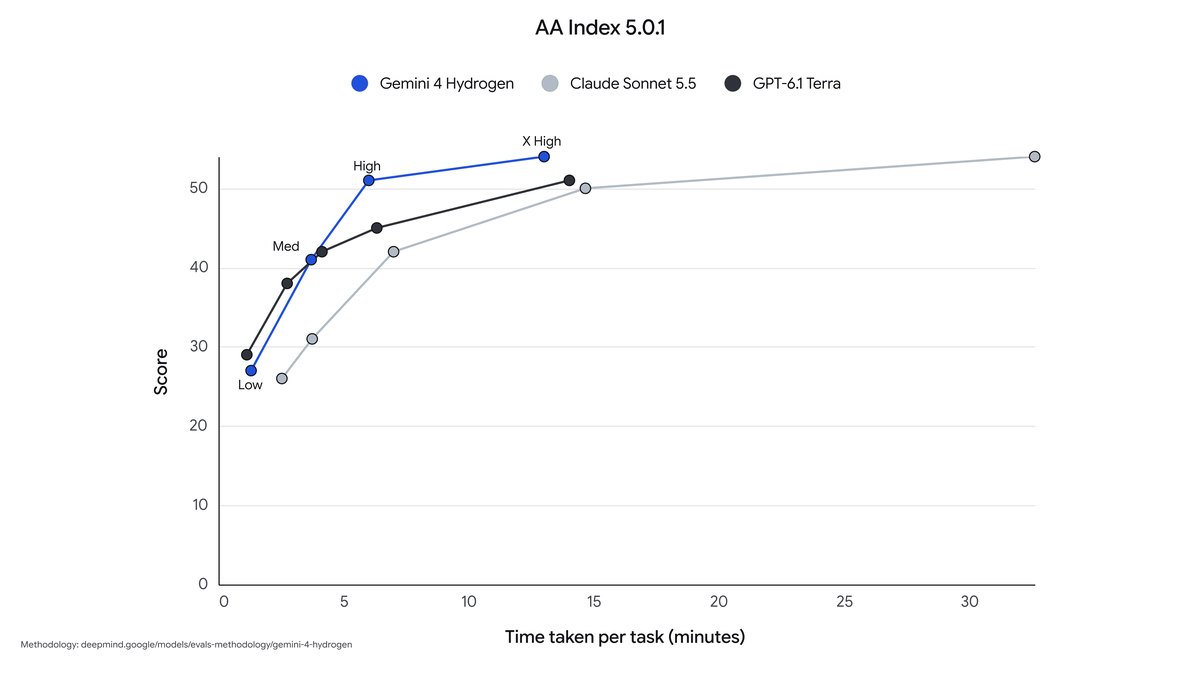
For teams migrating from 3.8 Flash, Google reports Hydrogen finishes tasks 2.5 times faster at its default setting, more than triples Terminal-Bench 4.1 (57% vs 18.2%), cuts fabricated claims by more than 5x, and recovers cleanly when a tool call fails or a search comes back empty.
Teamwork: Orchestrator pairs Hydrogen with Carbon
Hydrogen is designed to work alongside Google's frontier models. The new Orchestrator in Google Antigravity switches between Carbon and Hydrogen inside the same session. On Terminal-Bench 4.0 it reached near-Carbon task success while using 24% less quota and finishing 19% faster on average. For parallel work, Carbon can coordinate while Hydrogen runs the worker and verifier agents in isolated workspaces.
The full benchmark table
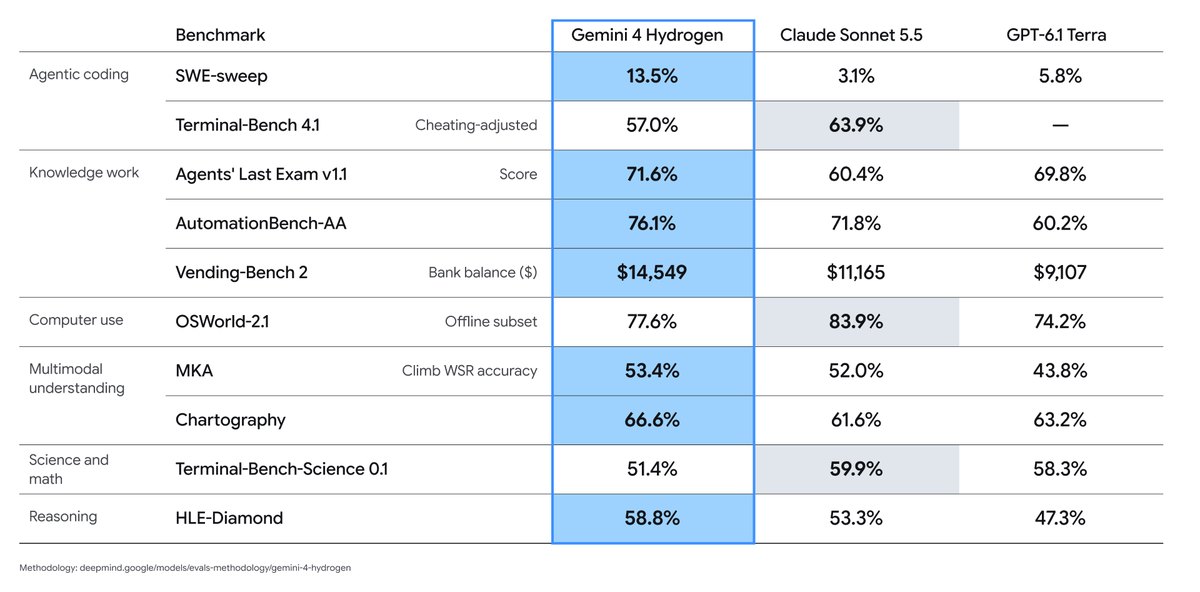
Against Claude Sonnet 5.5 and GPT-6.1 Terra, Google's table shows Hydrogen leading on SWE-sweep (13.5%), Agents' Last Exam v1.1 (71.6%), AutomationBench-AA (76.1%), Vending-Bench 2 ($14,549), MKA (53.4%), Chartography (66.6%) and HLE-Diamond (58.8%). It is not a sweep: Claude Sonnet 5.5 wins Terminal-Bench 4.1 (63.9% vs 57.0%), OSWorld-2.1 (83.9% vs 77.6%) and Terminal-Bench-Science 0.1 (59.9% vs 51.4%). Google also says Hydrogen ranks #5 on arena.ai's Agent Arena and #1 on the Vals Tax Agent Bench (52.3%). These are mostly Google-reported results; independent replication will take time.
Search: the biggest model upgrade yet
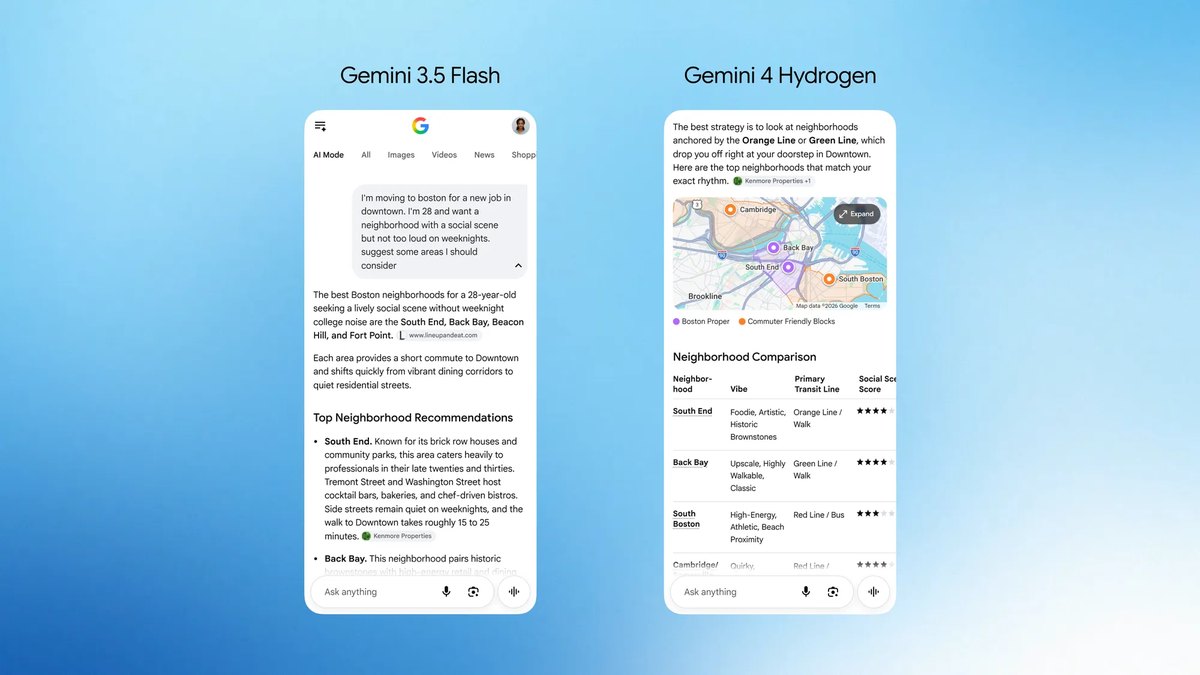
Google Search VP Robby Stein called Hydrogen the biggest model upgrade to Search yet, available globally for all users. Search now handles multi-part questions, typos and very specific requests, fans out to a broader range of links, and answers with more images, comparison tables and custom tools across every AI Mode language. In the Gemini app, free users get Hydrogen through auto model selection when it fits the prompt.
Safety numbers worth knowing
- Up to 81% less overreach and 79% less under-service in agentic tasks, and 12x fewer misaligned actions and task shortcuts versus 3.8 Flash.
- Up to 2x less likely to bypass permission boundaries on impossible or blocked tasks, with a 96.7% honesty rate on Google's agent honesty evaluation.
- 99.9% chain-of-thought legibility with zero deceptive reasoning edits across 200,000+ audited turns.
- 2.3x more resilient to indirect prompt injection on the Gray Swan IPI benchmark, and false refusals on HealthBench Pro under 0.4%.
Details are in the Gemini 4 Hydrogen model card. For a sense of how other labs frame safety at the frontier, compare Anthropic's approach in our Claude Fable 5.2 and Mythos 5.2 breakdown.
How to try it
Developers can call gemini-4-hydrogen through the Gemini API in Google AI Studio and Android Studio; Google's What's New guide covers setup and thinking-level controls, and the developer announcement links the Antigravity integration (paid Google AI Pro and Ultra subscribers). Enterprises can deploy it in Gemini for business and Gemini in Google Sheets. If you need fast, cheap yes/no judgments rather than generated text, Google's other launch this week, the Gemini Decisions API, pairs well with it.
What it means, and what is still unknown
Hydrogen narrows the gap between cheap and capable: a default model priced like a workhorse that scores like Google's previous frontier tier. The open questions are independent benchmark results, real-world rate limits, and how often Orchestrator routes to Carbon (and spends Carbon-level quota) on hard tasks.
Sources
- Google: Introducing Gemini 4 Hydrogen (Nov 12, 2026)
- Google: Gemini 4 Hydrogen for developers
- Google: Search gets a major upgrade with Gemini 4 Hydrogen
- Google DeepMind: Gemini 4 Hydrogen model card (PDF)
- Google AI Studio: What's new in Gemini 4 Hydrogen
- Google Antigravity: Gemini 4 Hydrogen and Orchestrator
- Artificial Analysis
- Terminal-Bench 4.0
- arena.ai Agent Arena leaderboard
- Vals AI: Tax Agent Bench
Frequently asked questions
What is Gemini 4 Hydrogen?
A fast, low-cost Gemini 4 model Google released on November 12, 2026 for everyday coding and agentic workflows. It replaces Gemini 3.8 Flash as Google's high-volume default and runs standalone or alongside Gemini 4 Carbon and Argon.
How much does Gemini 4 Hydrogen cost?
$1.50 per million input tokens and $7.50 per million output tokens, flat across its full 1 million-token context window.
Is Gemini 4 Hydrogen better than Gemini 4 Argon?
On the Artificial Analysis Intelligence Index it scores 51 at its default high thinking level versus 50 for Argon, and 54 at xhigh. Argon and Carbon remain Google's models for deep, long-horizon reasoning.
What is Orchestrator in Google Antigravity?
A mode that switches between Gemini 4 Carbon and Hydrogen within one session. On Terminal-Bench 4.0 it reached near-Carbon success while using 24% less quota and finishing 19% faster.
Where can I use Gemini 4 Hydrogen?
Google Search (all users, globally), the Gemini app, Google AI Studio, the Gemini API, Android Studio, Gemini for business, Gemini in Google Sheets and, for paid AI Pro and Ultra subscribers, Google Antigravity.
From the blog
View all posts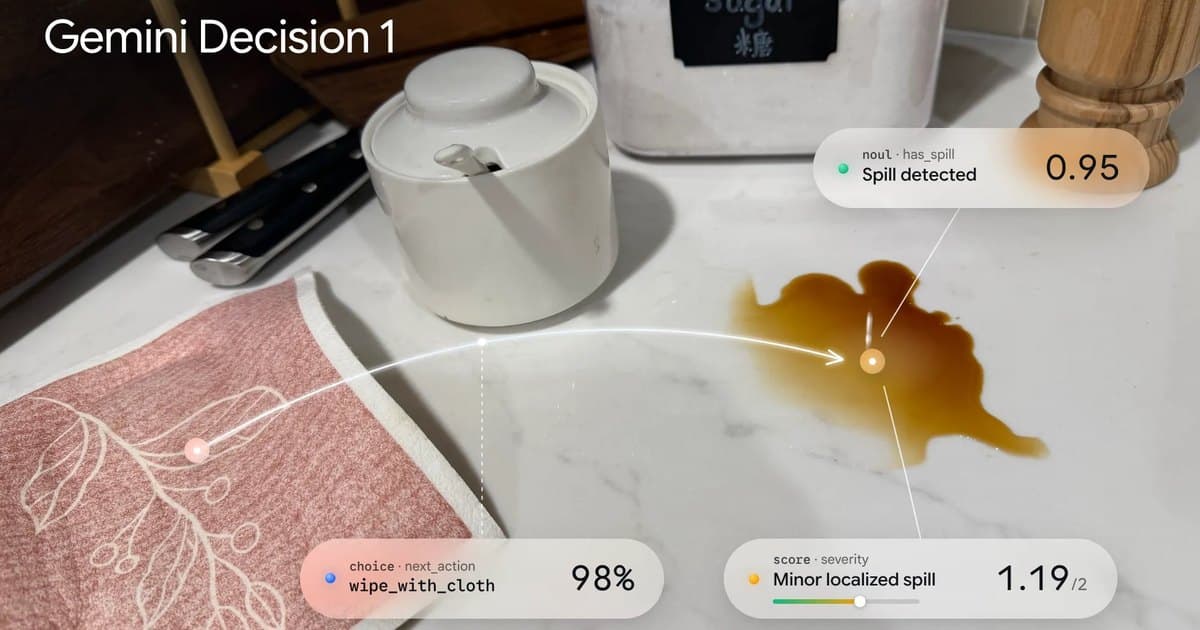
Gemini Decisions API Explained: Gemini Decision 1 Answers 1,000 Questions in One Pass for $0.10 per Million Tokens
On November 11, 2026, Google launched the Gemini Decisions API and its new Gemini Decision 1 model. Instead of writing text, it scores yes/no, multiple-choice and rubric questions against one multimodal input, up to 1,000 at a time, returning calibrated probabilities in 150 to 250 ms at $0.10 per million input tokens with no output-token charges.


Gemini Robotics 2.5 Explained: Google DeepMind's Most Dexterous Robot Model, Apollo 2 at Mercedes-Benz and the Safety Numbers
On November 10, 2026, Google DeepMind introduced Gemini Robotics 2.5, its most capable vision-language-action model. Tested on 200+ tasks it scores 30% to 100% higher success than Gemini Robotics 2 and finishes 20% to 30% faster, helped Apptronik's Apollo 2 humanoid kit parts with a 96% success rate on Mercedes-Benz lines, and completes tasks safely 43% more often around people.