Google DeepMind's Gemini Agents Found Faster Quantum Algorithms and Proved Them in Lean
Teams of Gemini 4 agents at Google DeepMind cut the cost of quantum programs for fusion, drug-metabolism and photochemistry simulations by up to 11.8x, made a common arithmetic routine 290x cheaper, and proved every circuit correct in the Lean theorem prover. Here is what they found, how the agent teams worked and what it does and does not mean for quantum computing.

What Google DeepMind announced
On November 23, 2026, Google DeepMind published "Finding faster quantum algorithms with agents and formal verification", written by Sergey Shirobokov, Ben Jaderberg and Ryan Babbush. The team used teams of Gemini 4 agents to improve well-known quantum algorithms and produce much cheaper quantum circuits, the step-by-step instructions a quantum computer follows. Because these circuits are far too big to test on any classical computer or on today's small quantum processors, every result was proved mathematically in the Lean theorem prover instead of being tested. The full details are in the paper "Discovering formally verified quantum programs with AI" (arXiv 2611.09822), a collaboration between Google DeepMind and Google Quantum AI. This page is the long-form briefing behind the BSH Technologies Instagram carousel, with each claim linked to DeepMind's post or the paper.

The results at a glance
DeepMind reports improvements on five problems. The cost metric for error-corrected (fault-tolerant) machines is the spacetime cost: the number of logical qubits multiplied by the number of T gates, the expensive operations in an error-corrected quantum computer.
- Fusion: 11.8x lower cost for computing stopping power in inertial confinement fusion, with memory down from 5,650 to 4,338 error-corrected qubits.
- Photochemistry: 8x cheaper simulation of a common light-sensitive molecule (non-Born-Oppenheimer dynamics).
- Drug metabolism: 2.5x cheaper simulation of the cytochrome P450 enzyme, with memory down from 481 to 333 qubits.
- Grover search: up to 2.57x fewer expected oracle rounds for a specific parallel implementation of Grover's algorithm.
- Fixed-point arcsin: a 290x lower spacetime cost for a routine many quantum algorithms use to load numbers into quantum states.
1. A laser-fusion simulation got 11.8x cheaper
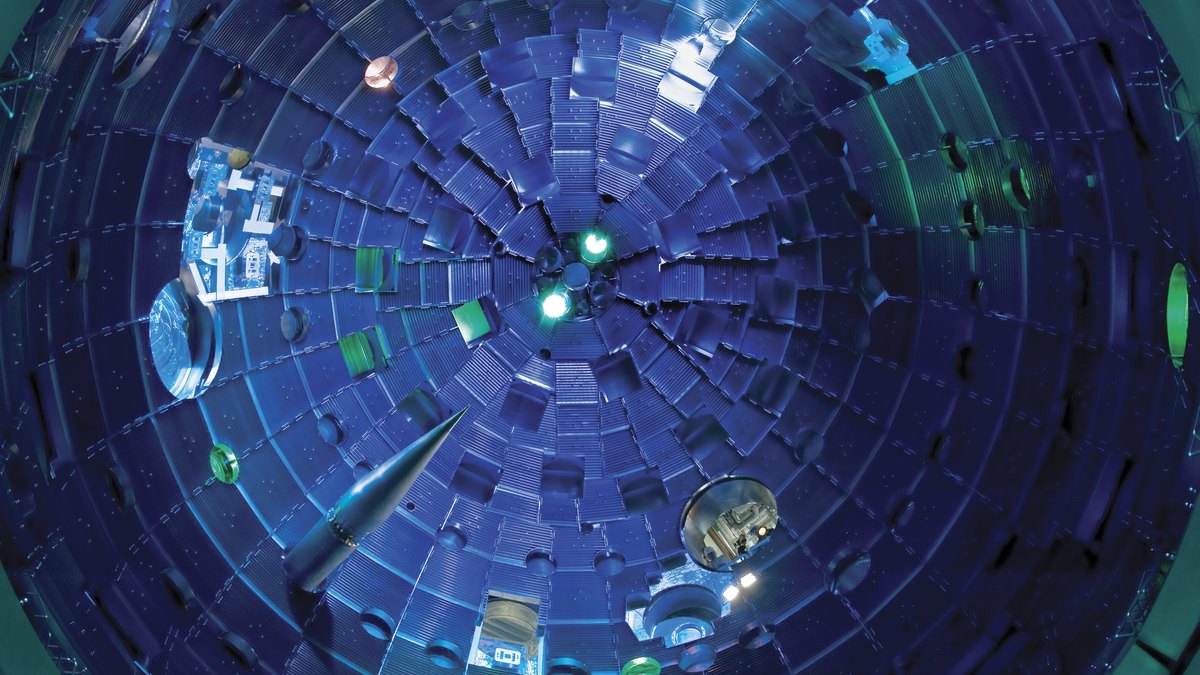
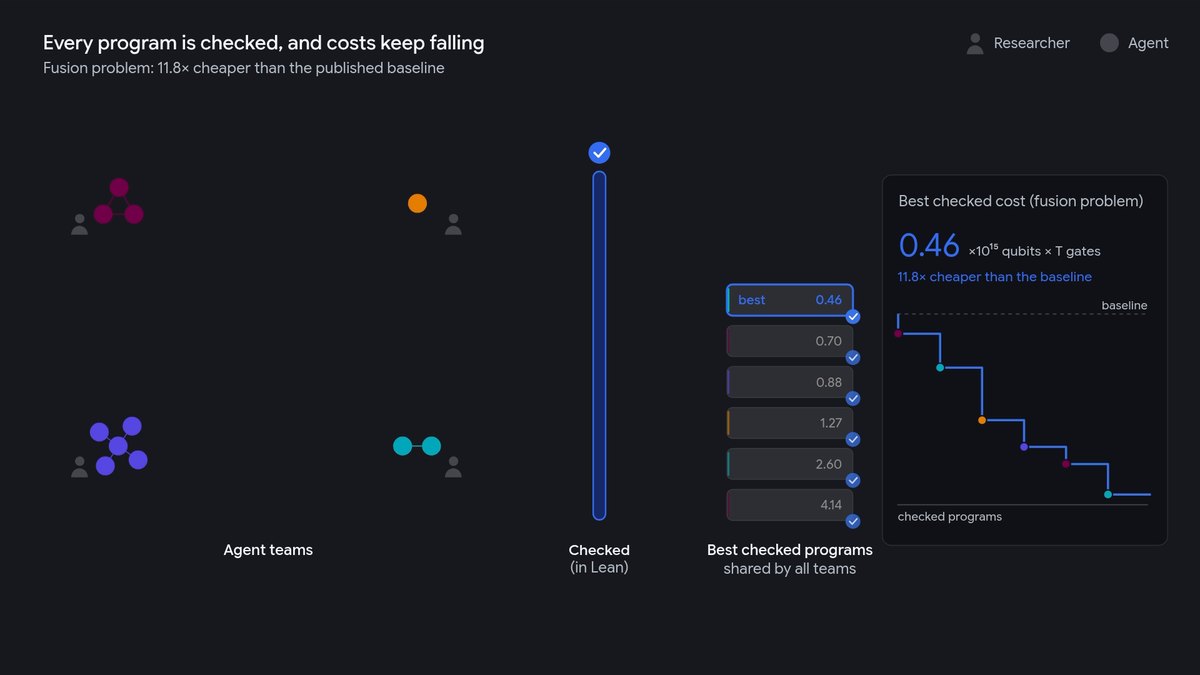
Inertial confinement fusion uses powerful lasers to compress hydrogen fuel until it ignites, the approach used at Lawrence Livermore National Laboratory's National Ignition Facility. A key property is stopping power: how quickly alpha particles lose energy as they move through hot, dense fuel. DeepMind's agents found a circuit for this calculation that cuts the computing cost by 11.8x and lowers the memory needed from 5,650 to 4,338 error-corrected qubits, according to the DeepMind post. The paper rounds this to roughly 12x.
2. Drug-metabolism and light-sensitive molecules got cheaper to simulate
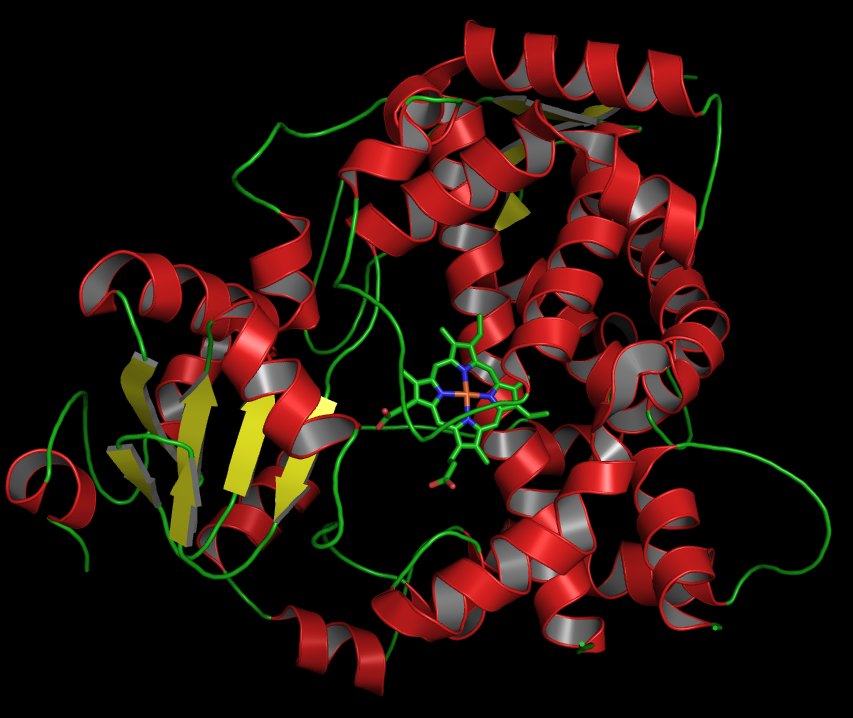
Cytochrome P450 is the enzyme family that breaks down most human medicines, which makes it central to drug design. Simulating its electronic structure is one of the classic "killer apps" proposed for quantum computers. DeepMind says the agent teams found a 2.5x improvement and cut memory from 481 to 333 qubits by replacing bulky memory lookups. For a common light-sensitive molecule, the agents made the quantum simulation 8x cheaper by simplifying how the algorithm tracks particle positions and electric forces. If you read our piece on GPT-6 designing proteins that worked in the lab, this is the same theme from a different angle: AI shortening the path to better medicines.
3. Core building blocks got faster too
Beyond the science problems, the agents improved two basic pieces of quantum software. They found a 2.57x speedup for a specific implementation of Grover's algorithm, the quantum method for searching an unsorted list, and a 290x speedup for fixed-point arcsin, an arithmetic routine used to load numbers into quantum states. The paper explains that arcsin was found in two steps: first a fast search restricted to circuits that can be simulated classically, then a further 11% saving using a gate set that is hard to verify outside Lean.
4. How the agent teams worked
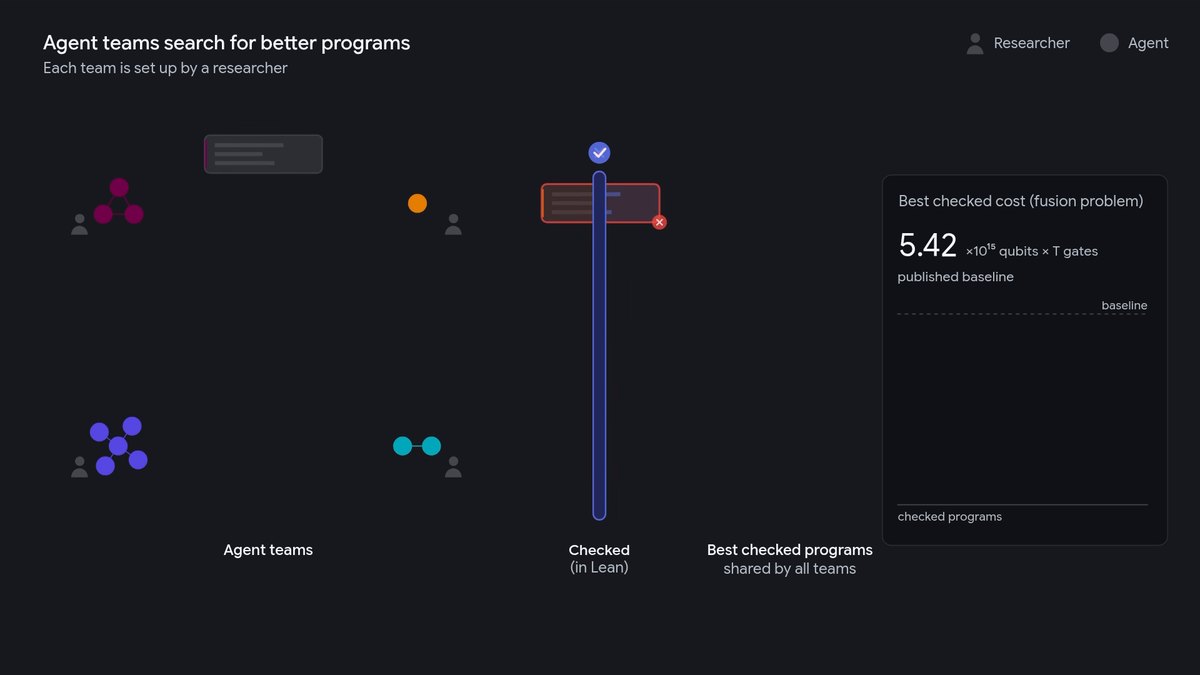
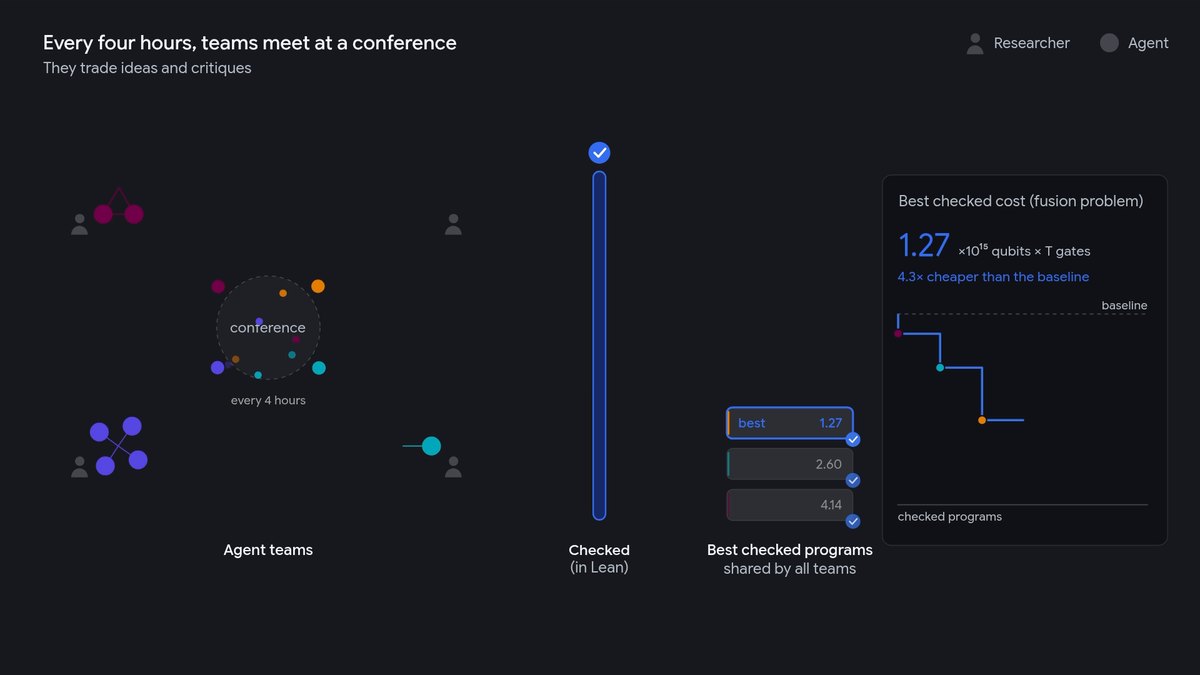
For each problem, DeepMind launched separate, independent agent teams, each set up by a researcher. The paper says all large-scale runs used Gemini 4 Carbon models. Teams wrote candidate programs, proved them in Lean, and posted verified results, reusable lemmas and notes on dead ends to a shared wiki. Every four hours, agents from all teams met at a virtual conference to trade, debate and compare ideas, and the best checked cost kept falling as the experiment ran.
5. Why Lean proofs matter here
Lean is a programming language and proof assistant that checks mathematical proofs line by line. DeepMind built a new open-source Lean library for quantum programs, grounded in quantum Hoare logic, and released it with the problem specifications and verified solutions as google-deepmind/formal-quantum-computation on GitHub. Researchers only need to review the frozen specification before a run. Because agents can edit files in their workspace, they might try to weaken a theorem or add an axiom; an external verifier using the Lean Comparator checks every submission against the original specification to block that. We covered the same idea of machine-checked AI results in Claude's Lean-verified Riemann Hypothesis proof.
6. The reality check
None of these circuits has run on a quantum computer. DeepMind is clear that running these scientific simulations would still demand more resources than the first error-corrected quantum computers are likely to provide, and the paper says reaching early hardware will need further orders-of-magnitude improvements. For context, Google Quantum AI's Willow chip, announced in December 2024, has 105 physical qubits, and each error-corrected qubit is built from many physical ones. The value of this work is that it shrinks the gap from the algorithm side, with proofs rather than estimates. Google has also used AI on the hardware side, for example AlphaQubit for error decoding, and our earlier report on DeepMind agents and RSA-1024 cryptanalysis shows how fast agent-driven research in this field is moving.

What it means for businesses and builders
- Quantum timelines depend on software too. A 12x cheaper fusion circuit or 2.5x cheaper enzyme simulation moves useful quantum chemistry closer, even if the hardware does not change.
- Verified AI output is becoming the standard for high-stakes work. Pairing agents with a strict checker, as DeepMind did with Lean, is a pattern any team can borrow for code, finance or compliance tasks.
- Agent teams beat lone agents on open problems. Shared memory (the wiki) and regular review (the conferences) are simple ideas that translate directly to multi-agent workflows in business.
If you want help designing verified, multi-agent AI workflows for your own team, talk to BSH Technologies.
Sources
- Google DeepMind: Finding faster quantum algorithms with agents and formal verification (Nov 23, 2026)
- arXiv 2611.09822: Discovering formally verified quantum programs with AI
- GitHub: google-deepmind/formal-quantum-computation
- Lean programming language and theorem prover
- Lean Comparator
- Lawrence Livermore National Laboratory: National Ignition Facility
- Google: Meet Willow, our state-of-the-art quantum chip
- Google DeepMind: AlphaQubit
Frequently asked questions
What did Google DeepMind's quantum agents find?
Teams of Gemini 4 agents found cheaper quantum circuits for five problems: 11.8x for a fusion stopping-power calculation, 8x for a light-sensitive molecule, 2.5x for the cytochrome P450 enzyme, 2.57x for a parallel Grover search and 290x for the fixed-point arcsin routine.
Why did DeepMind use Lean?
The circuits are too large to test on classical computers or today's quantum processors, so each one was proved correct, along with its resource cost, in the Lean theorem prover against a frozen specification checked by an external verifier.
Have these quantum algorithms run on a quantum computer?
No. DeepMind says the scientific simulations would still need more resources than the first error-corrected quantum computers are likely to provide. The improvements are proved mathematically, not run on hardware.
Which Gemini model did the agents use?
The DeepMind post describes teams of Gemini 4 agents, and the paper says all large-scale discovery runs used Gemini 4 Carbon models.
Is the code open source?
Yes. DeepMind released its Lean library for quantum programs, the problem specifications and the verified solutions on GitHub as google-deepmind/formal-quantum-computation.
From the blog
View all posts
Tasks in Gemini: Google's AI Now Makes Phone Calls, Fills Carts and Uses Your Mac
Google has turned Gemini from a chatbot into an assistant that does the errand: Tasks in Gemini can phone local businesses with Duplex, shop with the Agent Payments Protocol, act on forwarded emails and texts, and click through apps on your Mac. Here is what each feature does, who can use it and the safeguards Google built in.

Anthropic Rewrote Its Messages API in Rust With Claude: How It Verified the Migration
Anthropic moved the Messages API that serves Claude from Python to Rust, with Claude agents finding and fixing differences on shadowed production traffic. The result: about 70% less CPU per request, over 80% less memory and a 20% faster median time to first token, with no downtime. Here is how the verification worked and what it means for teams.