Microsoft's Agensh: 1,024 AI Agents With No Boss Rebuild Real Software, What It Scored, and the Catch
On October 24, 2026, Microsoft Research open-sourced Agensh, a multi-agent harness in which up to 1,024 AI coding agents organise themselves with no central orchestrator. On the hardest ProgramBench tasks the mean pass rate rose from 19.31% with one agent to 28.78% with 128, and Pandoc reached 55.06% with 1,024 agents. Here is how it works, what emerged, and the catch.
What happened
On October 24, 2026, Microsoft Research open-sourced Agensh, which it describes as "a self-organized multi-agent harness that scales to 1,024 agents". The release includes the harness, the experiment launch scripts and a reproduction guide, under the MIT License. The method itself was first described in the preprint "Agensh: Scaling Organizational Intelligence to 1,024 Agents", published on arXiv on September 22, 2026 by Zhihao Zhan, Ting Song, Li Dong, Shaohan Huang, Jianxun Lian, Yan Xia and Furu Wei. This page is the long-form briefing behind the BSH Technologies Instagram carousel; more explainers like it are on the BSH Technologies AI blog.
- What it is: a harness that lets many AI coding agents work on one big software goal at the same time.
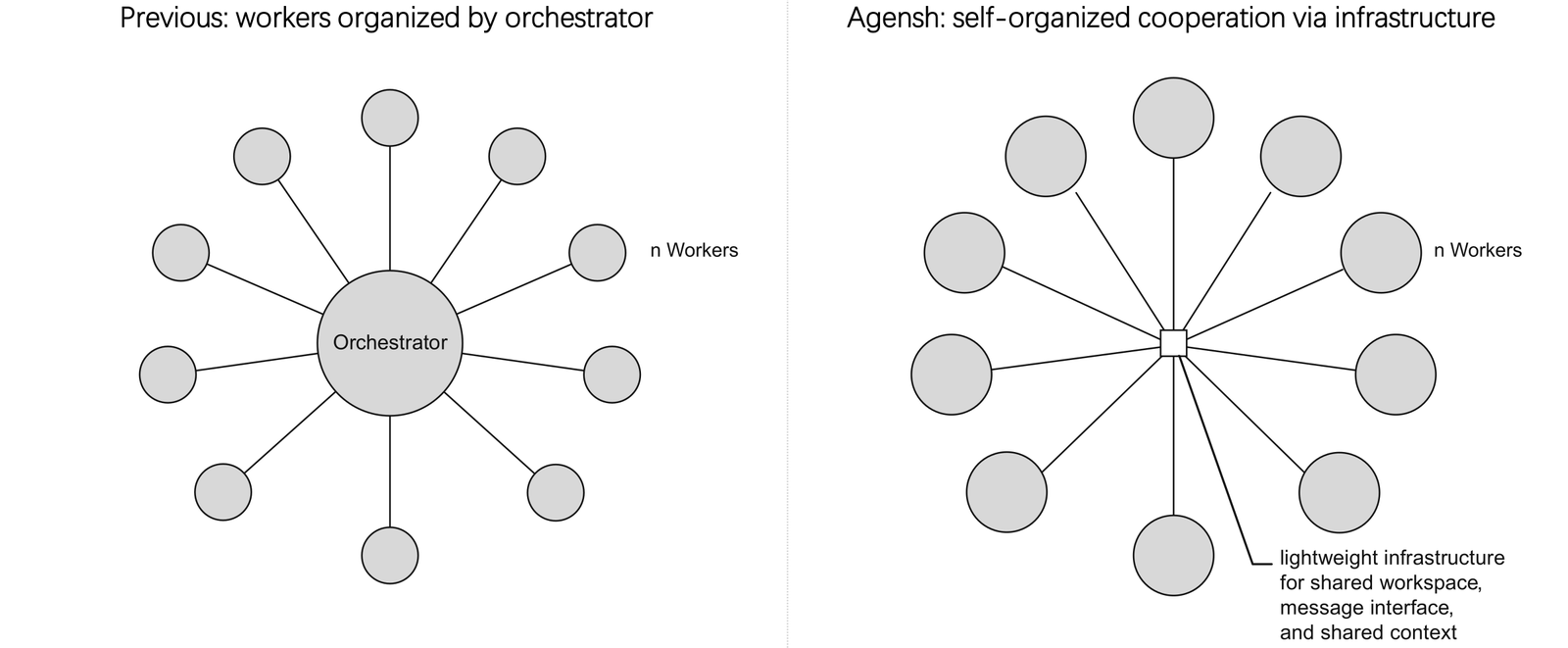
- What is different: there is no central orchestrator. Agents discover and claim sub-tasks themselves, share findings, verify results and merge progress asynchronously.
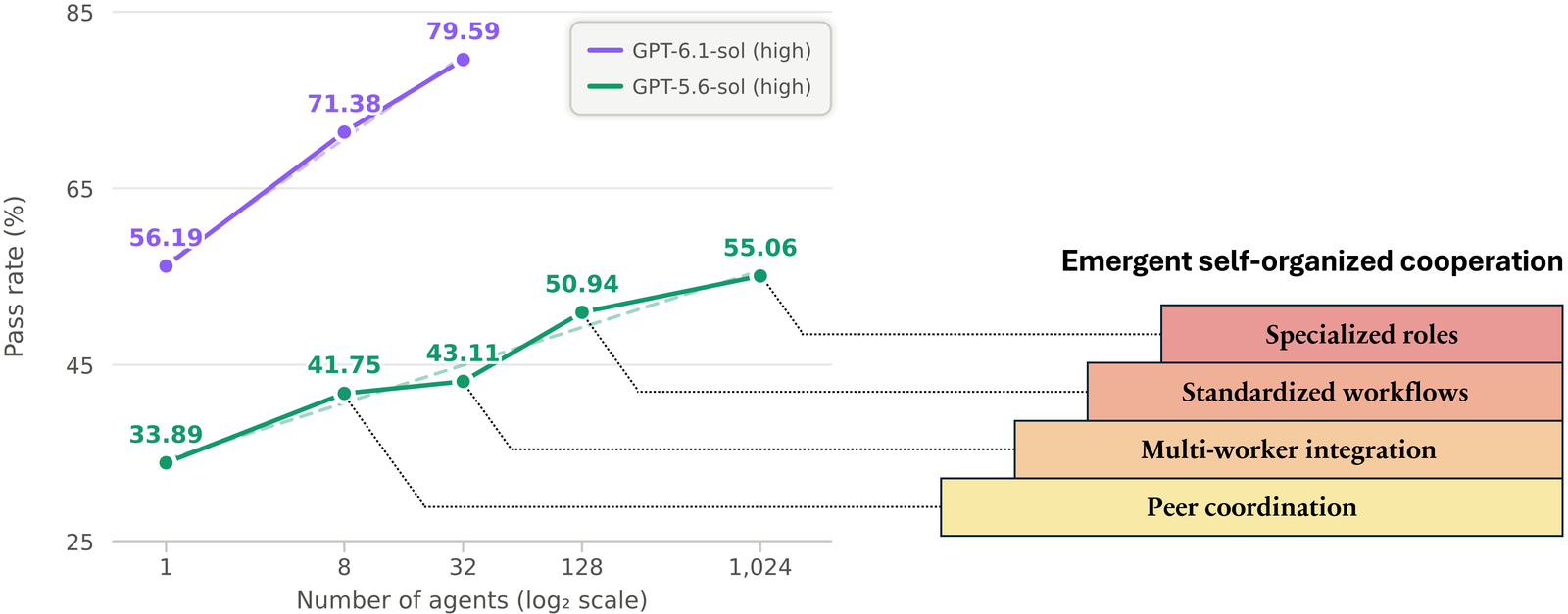
- Headline result: on Pandoc, one of the hardest ProgramBench tasks, the test-pass rate rose from 33.89% with one agent to 55.06% with 1,024 agents in the same six hours.
1. No orchestrator: a flat team
Most multi-agent coding setups put one lead agent in charge, splitting the goal and handing tasks to helpers. Agensh removes that role. According to the paper, every worker receives the same prompt, differing only in its ID, and decides for itself what to work on next by reading the shared state of the project.
It is the opposite design choice to agent products that wrap many tools around one assistant, such as Anthropic's Claude Duet proactive agent or OpenAI's always-on Dots agents.
2. How it works: a five-step loop on shared tools
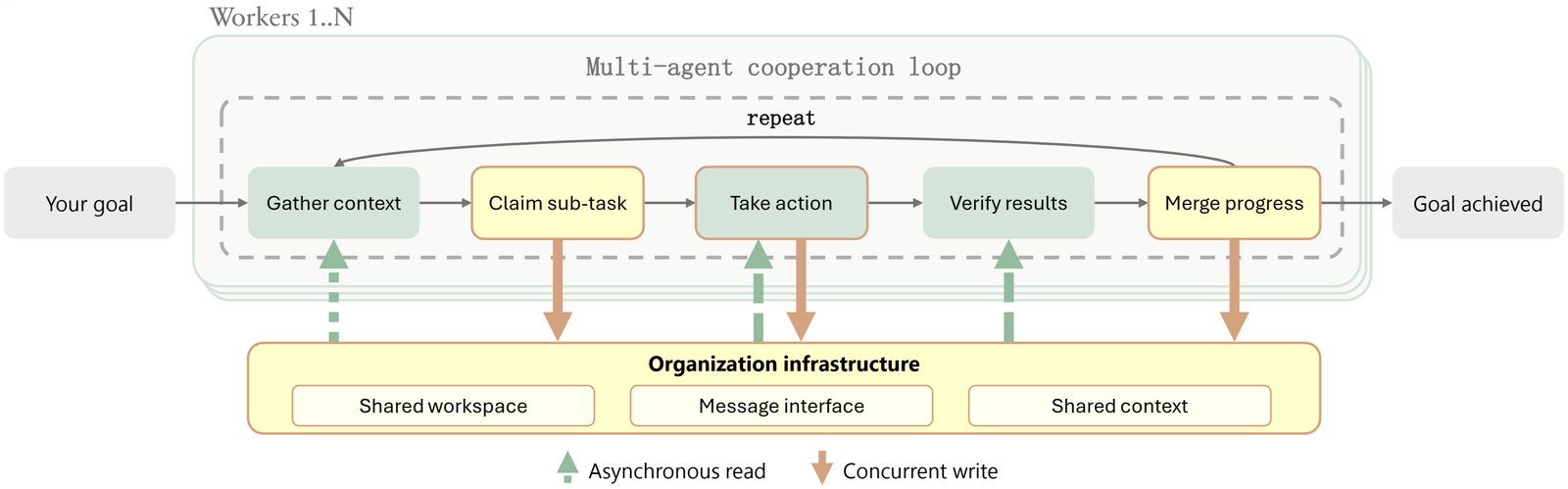
Each agent repeats one cooperation loop until the goal is met: gather context, claim a sub-task, take action, verify results, merge progress. All agents run asynchronously and share progress through three pieces of infrastructure:
- Shared workspace: a Gitea Git server holds the code everyone works on.
- Message interface: Mattermost carries agent-to-agent and channel messages.
- Shared context: a board of short records such as OBSERVED, FACT, FAIL, CLAIM and PATCH_SUMMARY, adapted from DeLM, so agents can see what others have learned, claimed or broken.
- Per-agent loop: each worker runs on the agentic loop of GitHub's Copilot CLI harness.
3. The results: 55% of Pandoc rebuilt from scratch
Microsoft tested Agensh on the five hardest tasks of ProgramBench (FFmpeg, GROMACS, Pandoc, PHP-src and ctags), where agents must rebuild a reference program from its observed behaviour and bundled documentation, then pass its hidden tests. Each run used GPT-5.6-sol at high reasoning effort, a six-hour budget and no internet access.
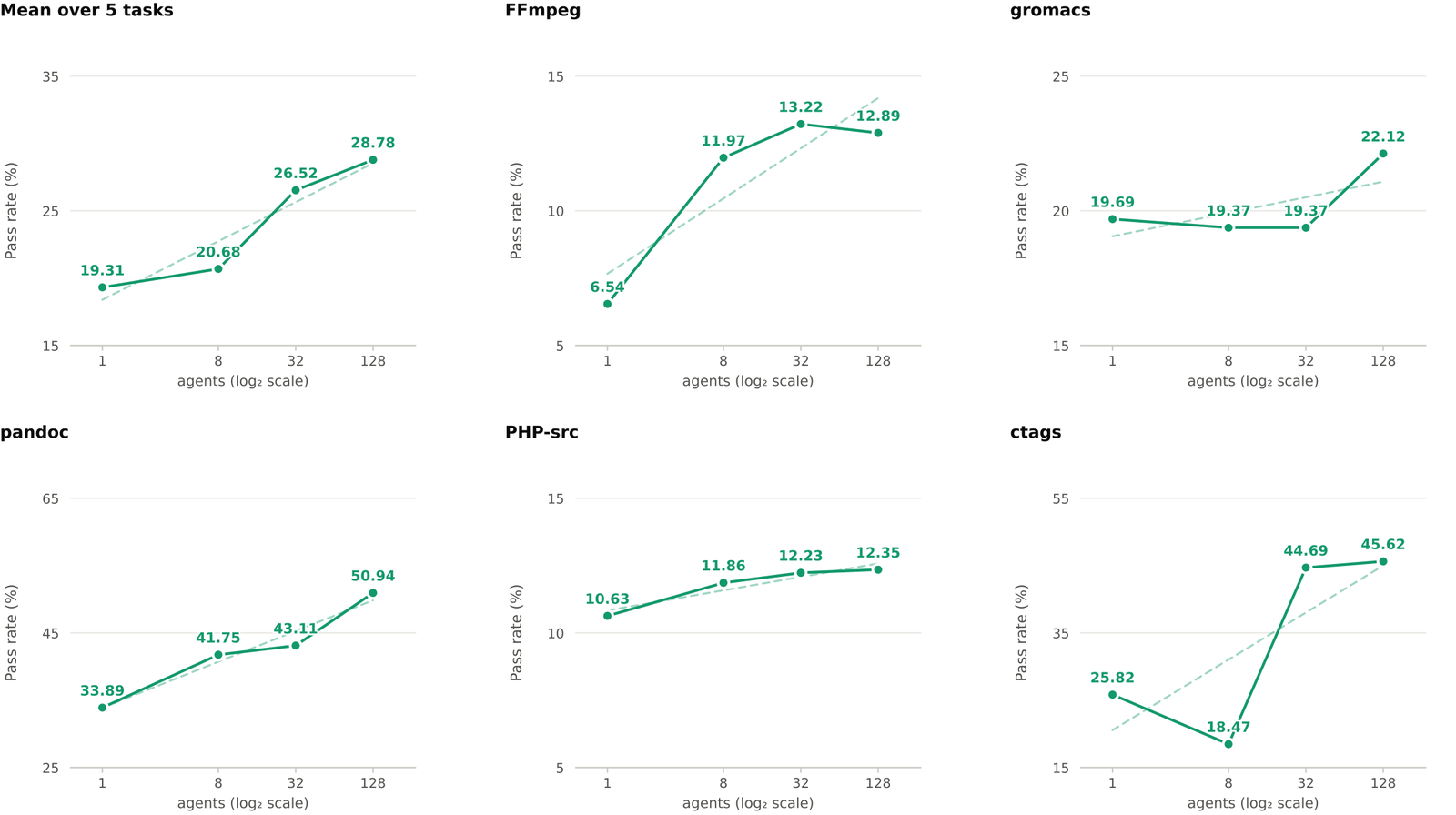
- Mean across the five tasks: 19.31% with 1 agent, 20.68% with 8, 26.52% with 32 and 28.78% with 128, roughly a 49% relative improvement.
- Pandoc: 33.89% (1 agent), 41.75% (8), 43.11% (32), 50.94% (128) and 55.06% (1,024).
- Faster, too: on Pandoc, 128 agents crossed a 30% pass rate in about 30 minutes, against roughly 60 minutes for 32 agents and 90 minutes for 8.
- Newer model: with GPT-6.1-sol, Pandoc went from 56.19% with one agent to 79.59% with 32 agents, a 41.64% relative gain. For context on these OpenAI models, see our GPT-6 Sol and Luna API pricing explainer.
4. Roles nobody assigned
Because no one hands out jobs, the researchers watched what structure the agents built themselves. As teams grew, they report that new behaviour appeared on its own:
- 8 agents: peer coordination, agents messaging each other to avoid clashing.
- 32 agents: multi-worker integration, with agents merging each other's work.
- 128 agents: standardised workflows and specialised reviewers.
- 1,024 agents: several agents taking on integrator roles. That run was spread across 16 nodes with 64 agents each.
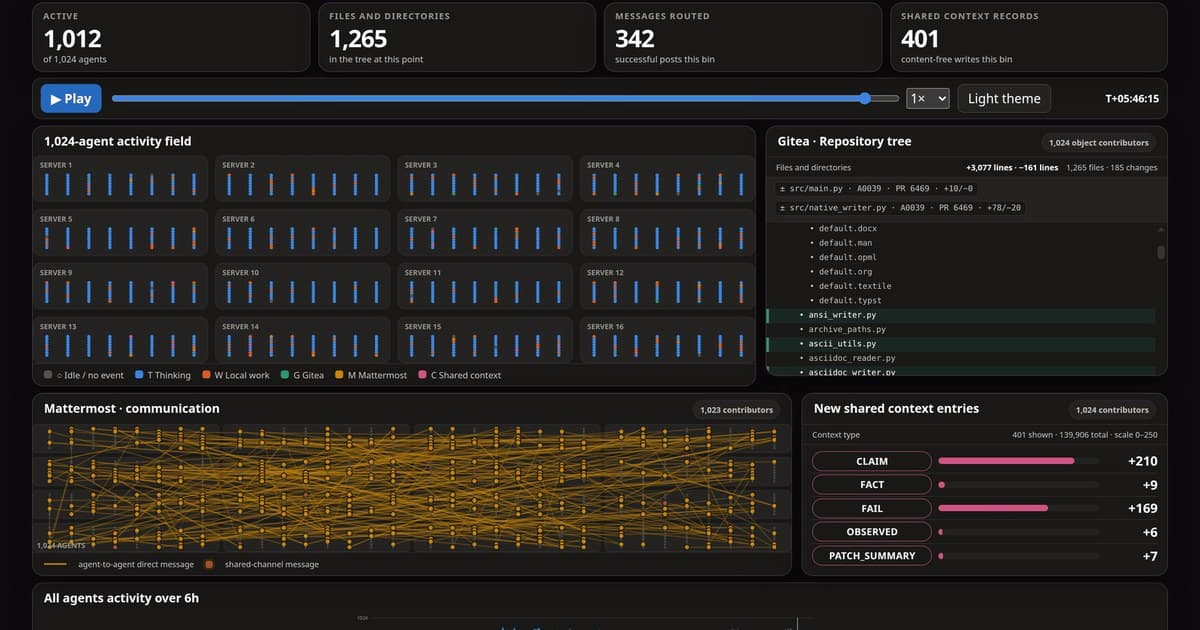
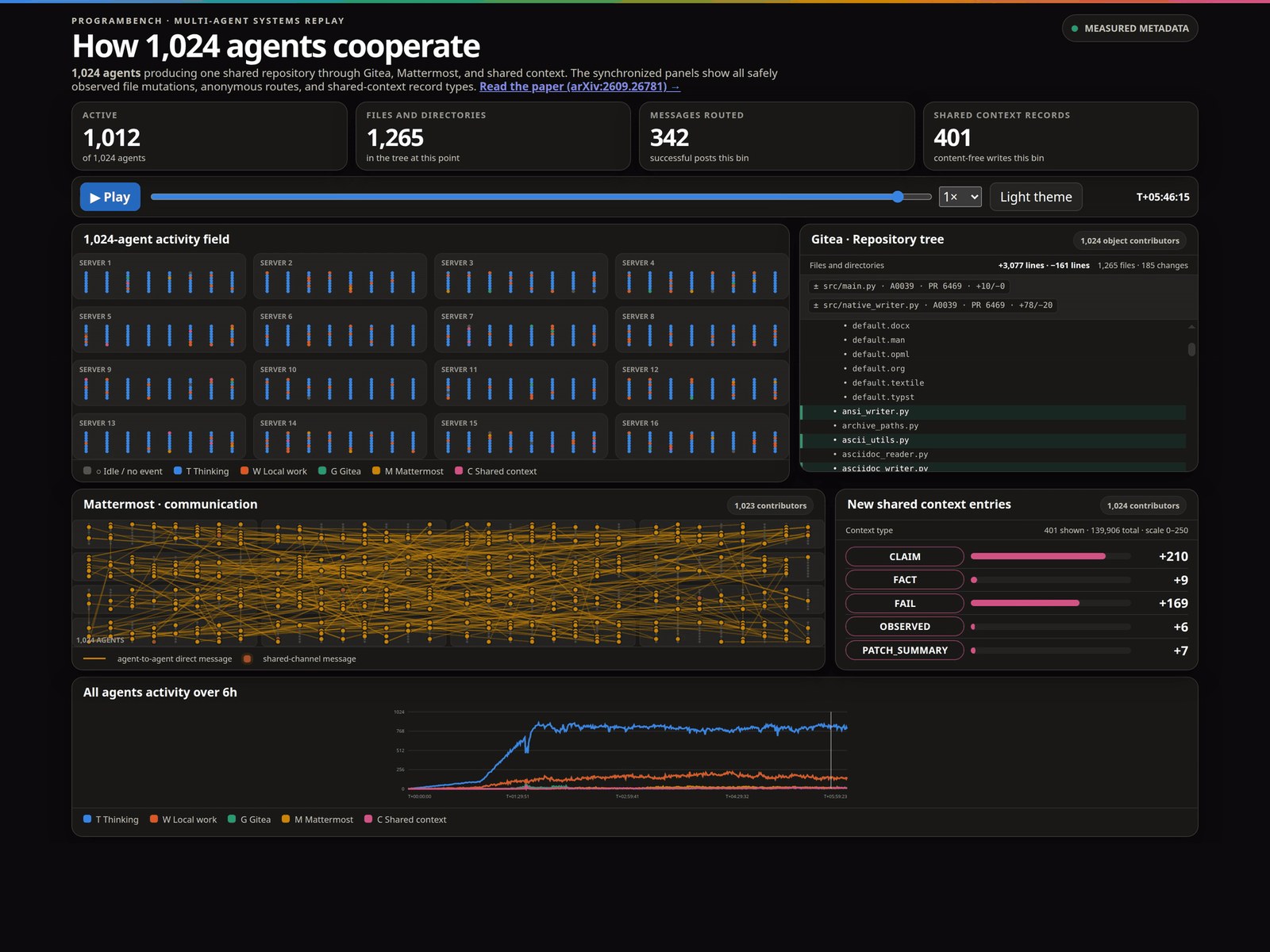
You can watch it in the interactive replay, where each dot and line is an agent action, Git change or message.
5. The catch
- More agents is not always better. Gains were uneven. FFmpeg peaked at 13.22% with 32 agents and slipped to 12.89% with 128. PHP-src barely moved, from 10.63% to 12.35%. GROMACS stayed at about 19-20% until 128 agents, and ctags fell from 25.82% to 18.47% at 8 agents before jumping to 44.69% at 32.
- No cost figures. The paper reports pass rates and time, not the token or dollar cost of running up to 1,024 frontier-model agents for six hours.
- Still far from finished software. Even the best GPT-5.6-sol run passes 55% of Pandoc's tests, and FFmpeg, GROMACS and PHP-src stay below 23% with 128 agents.
- Self-reported. All numbers come from Microsoft's own experiments on one benchmark and one model family, and have not yet been independently reproduced.
- Not plug-and-play. The public release is a single-node Docker Compose setup (defaults: 8 workers, 6 hours, GPT-5.6-sol) that needs Linux, Docker, cgroup v2 and passwordless
sudo. The 1,024-agent multi-node setup is not the default.
Why it matters for businesses
Agensh suggests that coding agents can share very large jobs without a manager agent becoming the bottleneck, using ordinary tools such as Git, chat and a shared notes board. It also shows the limits: returns shrink fast and costs are unknown, so for most teams a handful of well-supervised agents is still the practical choice. Microsoft has also been vocal about controlling powerful systems, see Satya Nadella's emergency-brake comments and its MAI-DxO medical AI. Like Moonshot's Kimi K3.1 Pro and the Hugging Face Carbon-X DNA model, this is a lab's own benchmark, so test it on your own work before planning around it. If you want help piloting AI coding agents on your codebase, BSH Technologies builds AI automation and cloud systems for teams like yours.
Sources
Frequently asked questions
What is Microsoft Agensh?
Agensh is an open-source multi-agent harness from Microsoft Research, released on GitHub on October 24, 2026 under the MIT License. It lets up to 1,024 AI coding agents work on one software goal with no central orchestrator, coordinating through a shared Git workspace (Gitea), chat (Mattermost) and a shared context board.
How does Agensh work without an orchestrator?
Every agent gets the same prompt, differing only by its ID, and repeats a loop: gather context, claim a sub-task, take action, verify results and merge progress. Agents see each other's claims, findings and failures through the shared infrastructure, so work is divided without a manager agent.
How well did Agensh perform?
On the five hardest ProgramBench tasks with GPT-5.6-sol, six hours and no internet, the mean test-pass rate rose from 19.31% with one agent to 28.78% with 128 agents. On Pandoc it rose from 33.89% to 55.06% with 1,024 agents, and with GPT-6.1-sol it reached 79.59% with 32 agents.
What are the limitations of Agensh?
Gains are uneven across tasks (FFmpeg and PHP-src barely improved), token and dollar costs are not reported, results are Microsoft's own on one benchmark, and the public release is a single-node Docker setup that needs Linux, Docker and passwordless sudo.
Can I run Agensh myself?
Yes. The GitHub repository includes a single-node Docker Compose team setup and a single-agent baseline. Defaults are 8 workers, a 6-hour budget per task and GPT-5.6-sol at high reasoning effort through native Copilot ACP sessions.
From the blog
View all posts
Moonshot AI's Kimi K3.1 Pro: a 3T-Class Open-Weight Model Close to Claude Opus 5.5, What It Costs, and the Catch
On October 23, 2026, Moonshot AI launched Kimi K3.1 Pro, a 2.8T-parameter model it calls its most capable 3T-class open-weight model. It scores 65.7% on Terminal-Bench 4.0, just behind Claude Opus 5.5, ranks 4th on the Artificial Analysis Intelligence Index and costs $2/$10 per million tokens. Here are the coding, 3D and finance results, the price, and the catch: weights are not out yet and Moonshot deliberately cut its cyber skills.

Hugging Face's Carbon-X: an Open Model You Can Chat With About DNA, Near GPT-6.1 Sol Scores at a Fraction of the Cost, and Its Limits
On October 22, 2026, Hugging Face released Carbon-X, an open 14.8B-parameter model that reads raw DNA inside an ordinary chat and answers in English. It averages 66.7% on five DNA benchmarks, close to GPT-6.1 Sol's 67.5%, at about 1/1,800 of the inference cost per problem. Here is how it works, the numbers, what it costs, how to run it locally and what it cannot do yet.