Moonshot AI's Kimi K3.1 Pro: a 3T-Class Open-Weight Model Close to Claude Opus 5.5, What It Costs, and the Catch
On October 23, 2026, Moonshot AI launched Kimi K3.1 Pro, a 2.8T-parameter model it calls its most capable 3T-class open-weight model. It scores 65.7% on Terminal-Bench 4.0, just behind Claude Opus 5.5, ranks 4th on the Artificial Analysis Intelligence Index and costs $2/$10 per million tokens. Here are the coding, 3D and finance results, the price, and the catch: weights are not out yet and Moonshot deliberately cut its cyber skills.

What happened
On October 23, 2026, Moonshot AI released Kimi K3.1 Pro, the first model in its new K3.1 series and, in Moonshot's words, its "most capable 3T-class open-weight model to date". It has a 1-million-token context window and comes with a faster sibling, K3.1 Pro Highspeed, which Moonshot says runs 2-3× faster. Both are live on Kimi.ai, Kimi Work, Kimi Code and the Kimi API, and Moonshot says the full model weights will be released by November 4, 2026. This page is the long-form briefing behind the BSH Technologies Instagram carousel; more explainers like it are on the BSH Technologies AI blog.

- Size: a Mixture-of-Experts model with 2.8T total and 104B active parameters, the same architecture as Kimi K3 (16 of 896 experts active per token), according to the Kimi K3 technical report and Artificial Analysis.
- What changed: K3.1 Pro is a post-trained Kimi K3 with much more reinforcement-learning compute, run jointly across hundreds of task domains.
- Independent ranking: 55 on the Artificial Analysis Intelligence Index, 4th overall, behind only Claude Opus 5.5 (58), Claude Sonnet 5.5 (56) and Muse Wonder Full (56), the model behind Meta's Muse Wonder personal agents.
- Price: $2 per million input tokens and $10 per million output tokens, 33% below Kimi K3.
1. Coding: within a point of Opus 5.5
- Terminal-Bench 4.0: 65.7%, ahead of GPT-6 Astra (58.2%) and narrowly behind Claude Opus 5.5 (66.4%). The test runs coding agents on realistic, resource-constrained terminal tasks with strict task-specific checks.
- SWE Marathon: 51.7, first on Moonshot's chart, ahead of Opus 5.5 (46.3) and GPT-6 Astra (42.5).
- Kimi Code Bench 3.0 Long-horizon: 61.2%, up from Kimi K3's 55.95%. This is Moonshot's internal benchmark.
- Where it trails: Terminal-Bench Science 0.1 (38.1 vs 68.1 for GPT-6 Astra) and OSWorld V2.1 (79.6 vs 81.8 for Opus 5.5).
- Long-horizon example: in one internal test it built a human walking simulator on the open-source human-atlas body model. Over 167 missions it found and fixed 36 errors in shoulder-muscle moment-arm calculations, taking the simulated body from collapsing within seconds to walking for 11.2 seconds.
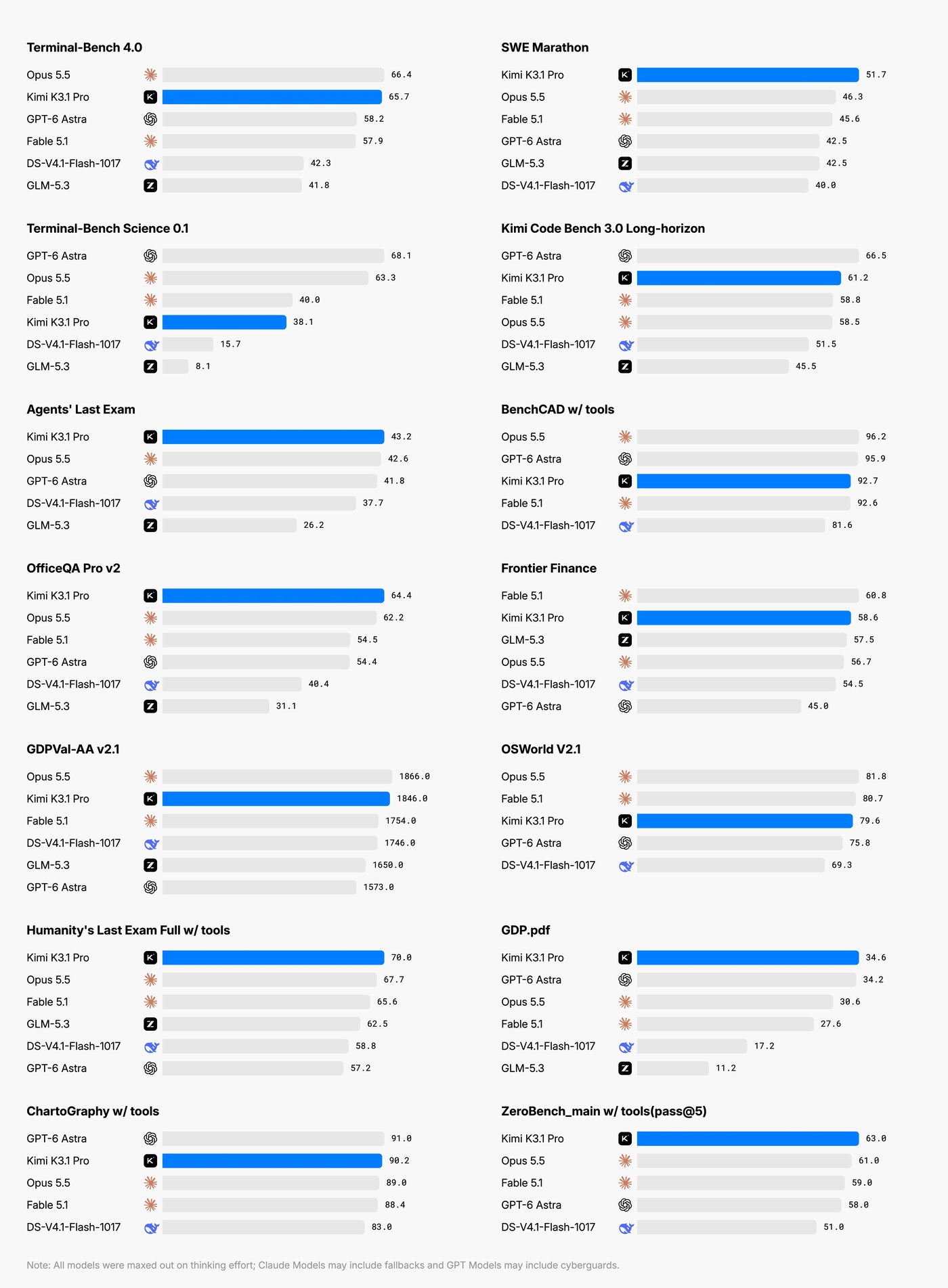
The chart also includes DeepSeek's latest open model, which we covered in DeepSeek V4.1-Flash-1017 and its search API. K3.1 Pro leads it on every benchmark shown.
2. 3D modelling: from a text brief to a printable model
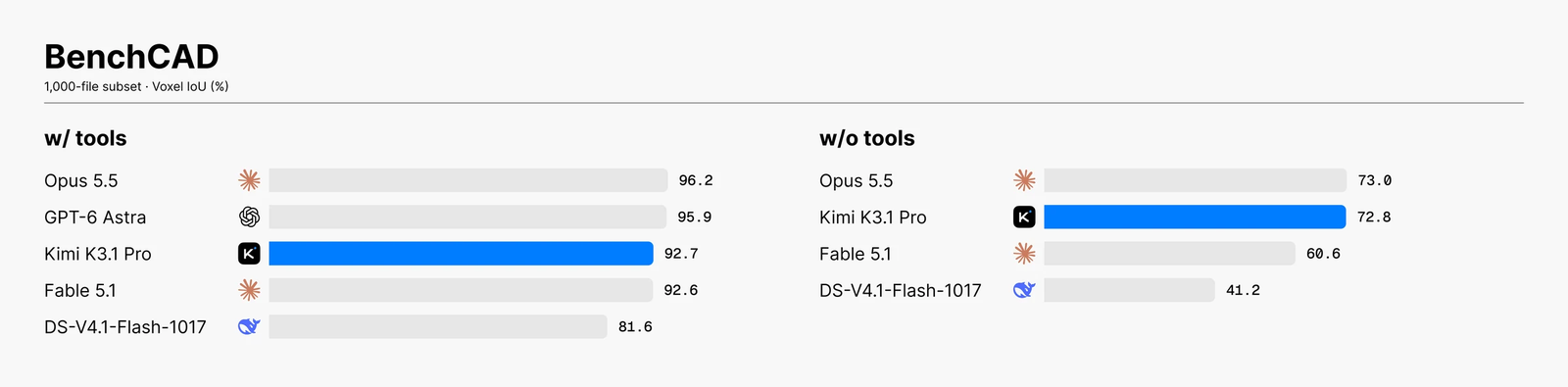
- BenchCAD: 92.7% with tools on 3D reconstruction through CAD code, close to Claude Opus 5.5 (96.2%) and GPT-6 Astra (95.9%) but still behind both.
- Tools without connectors: Moonshot says it writes and runs scripts for Blender and CAD software on its own, without MCP connectors, to build and edit assets.
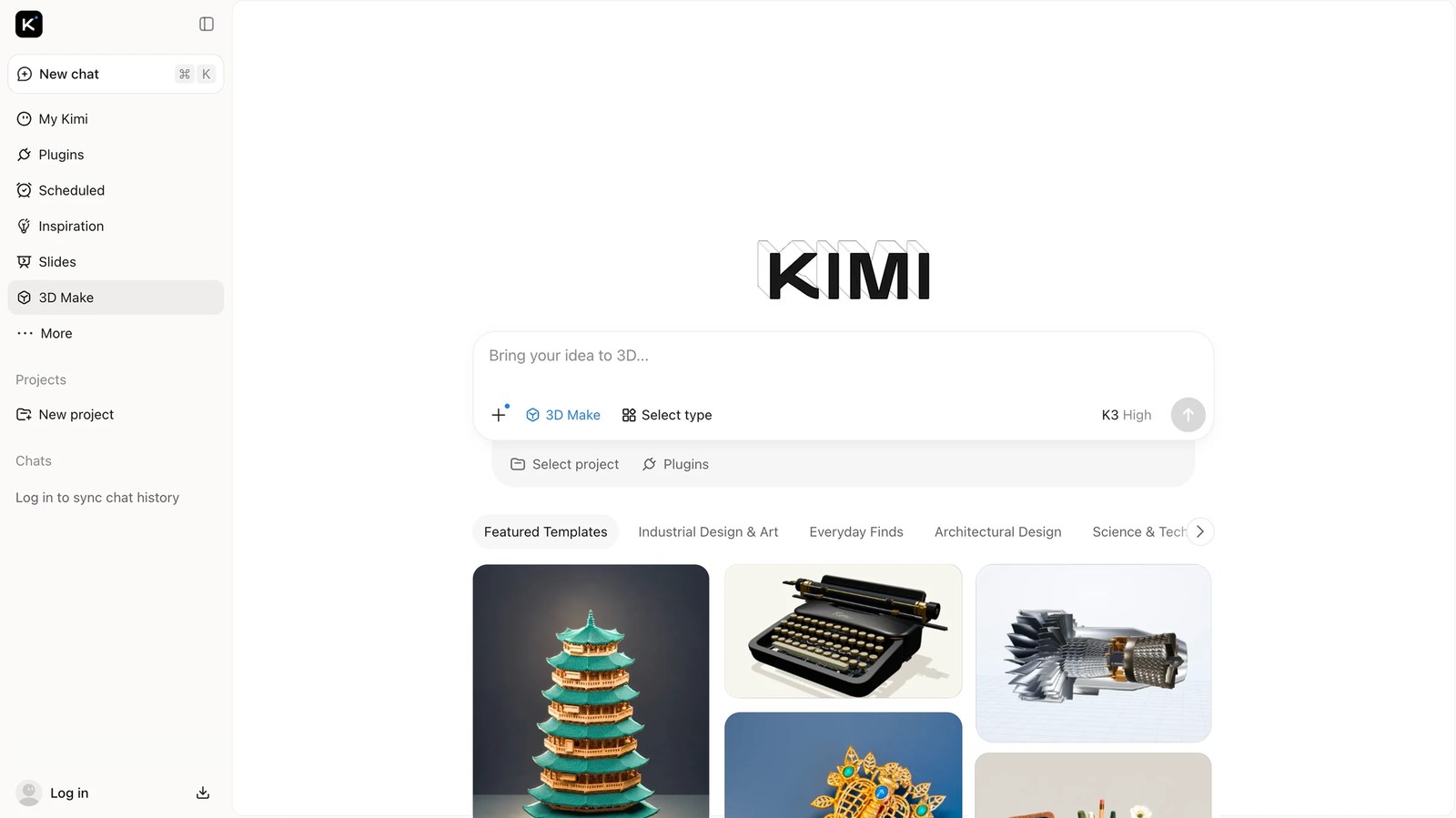
- 3D Make: a new mode on kimi.ai and in the Kimi app to preview and edit 3D models, download them ready for 3D printing, or export them as videos.

3. Finance work and fewer made-up facts
- OfficeQA Pro v2: 64.4, state of the art on Moonshot's chart (Opus 5.5: 62.2). The test checks fiscal analysis across real financial documents rendered as images.
- Internal finance tests: +7.2 points on financial modelling and +11.6 on financial research over Kimi K3, and about 4.2× K3's score in a simulated business-operations environment.
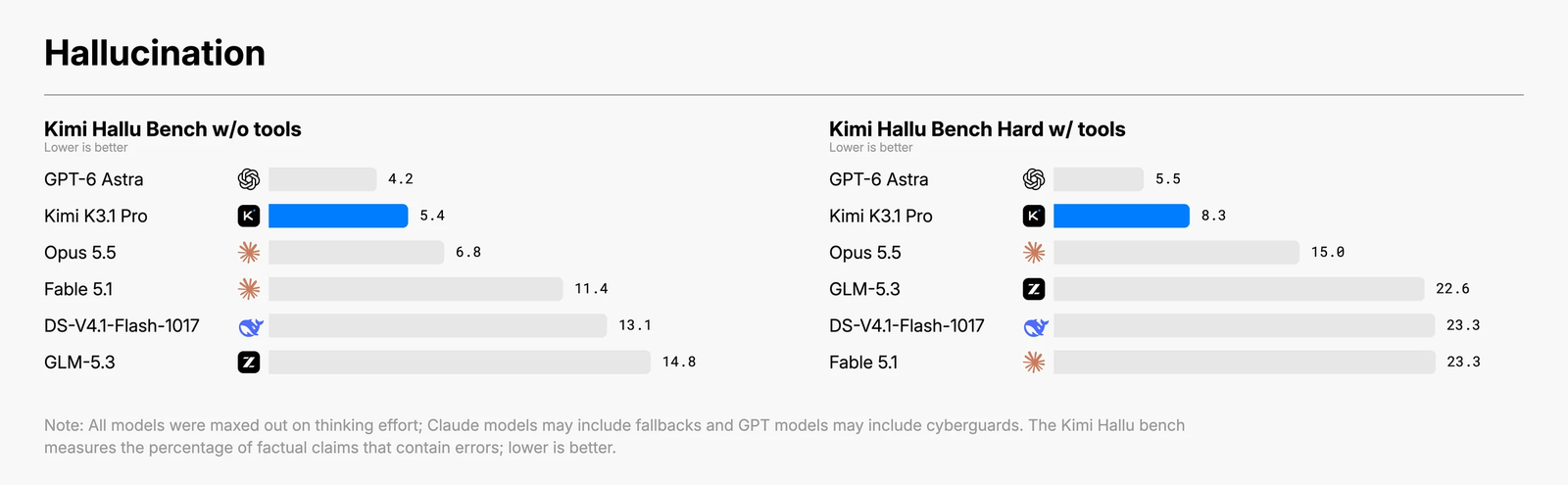
- Hallucinations: on Moonshot's internal Kimi Hallu Bench Hard, the claim-level hallucination rate fell from 23.4% for K3 to 8.3%. GPT-6 Astra still does better at 5.5%. Moonshot says this is a deliberate stress test and the rates do not represent everyday error rates.
4. Price, access and specs
- API: model IDs
kimi-k3.1-proandkimi-k3.1-pro-highspeedon an OpenAI-compatible endpoint. Moonshot's quickstart says the flagship unlocks after a minimum $1 top-up, thinking is always on, and reasoning effort can be set to low, high or max. - Pricing: $2 input, $10 output and $0.20 cached input per million tokens, with no tiering by context length. Artificial Analysis puts its cost at about $1.98 per Index task, roughly the same as Kimi K3: prices are 33% lower, but it uses 14% more output tokens per task. Compare OpenAI's GPT-6 Sol and Luna API pricing.
- Privacy: Zero Data Retention is available for API customers.
- Open weights: promised by November 4, 2026. Once out, Artificial Analysis expects K3.1 Pro to be the top open-weights model, narrowing the gap to the best proprietary model from 12 points to 3. For the hardware side of running very large open models yourself, see Meta's Muse Spark Open on two Mac Studios.
5. The catch
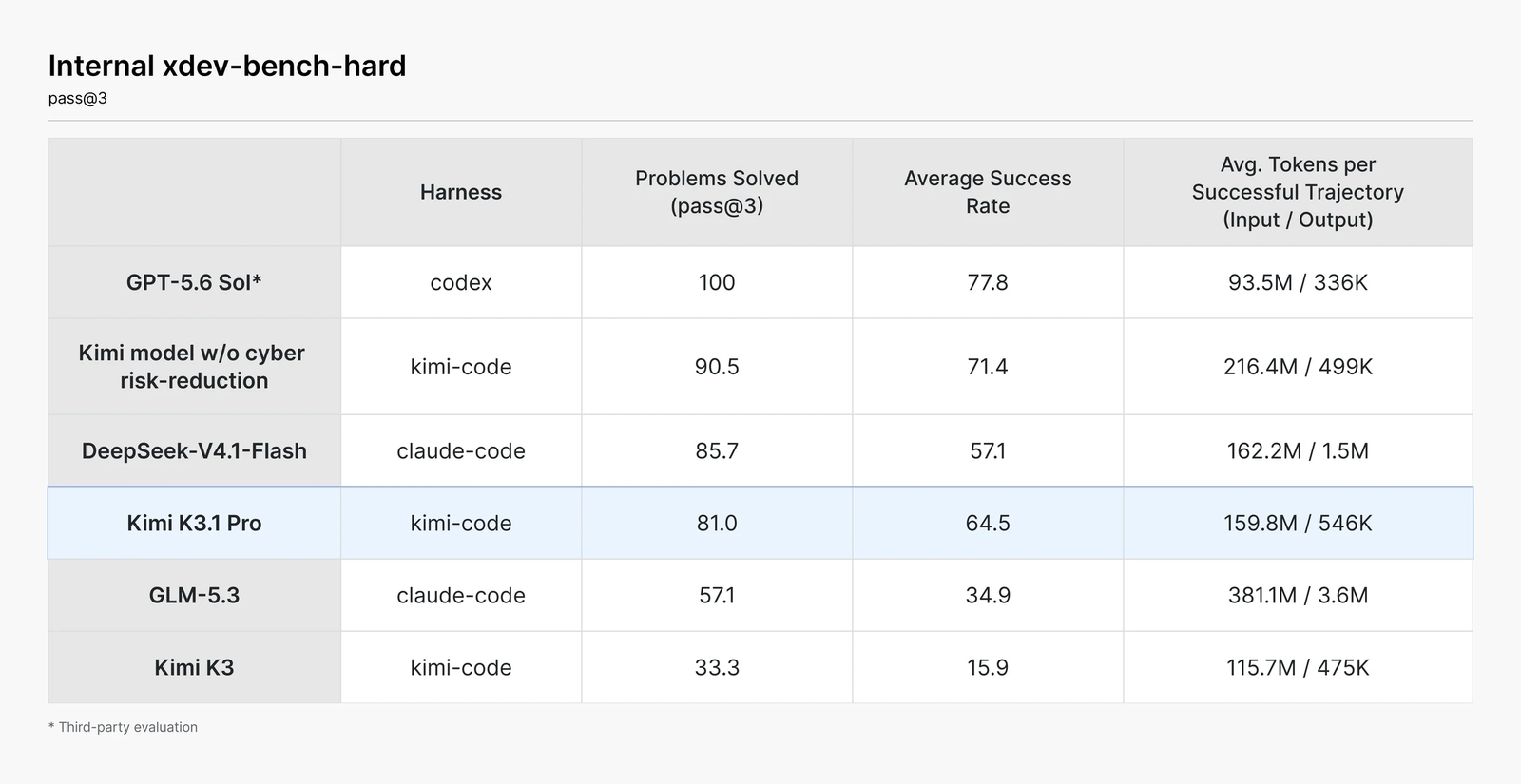
- Cyber skills were cut on purpose. Moonshot removed cyber-related data from mid-training and filtered cyber tasks out of RL. On its internal xdev-bench-hard exploit benchmark, a checkpoint without those measures solves 90.5% of problems at pass@3; the released K3.1 Pro solves 81.0%. Moonshot says it aims "not to release open weights that would extend the absolute frontier of cyber capability". For how a closed lab handles the same problem, see Google's Gemini 4 Argon programme for cyber defenders.
- The weights are not out yet. Until they are, "open-weight" is a promise, and the open release could differ from the hosted model.
- Mostly self-reported. Most numbers come from Moonshot's own charts and several benchmarks are internal. Artificial Analysis's independent index is the main outside check so far.
- A marketing allegation. Runtime Wire reports that screenshots of a creator brief for the launch allegedly asked paid creators not to add paid-partnership labels. The screenshots have not been independently authenticated and the brief's issuer is unknown.
Why it matters for businesses
K3.1 Pro narrows the gap between open and closed models to a few points on agentic coding, at a lower token price. Once the weights ship, a team could in principle run a near-frontier model on infrastructure it controls. Like the Hugging Face Carbon-X DNA model, it is also a reminder to check vendor benchmarks against your own tasks before switching. A sensible next step is a side-by-side pilot on your own codebase or documents, comparing quality, cost per task and data-handling terms. If you want help running that evaluation or building an AI agent on top of it, BSH Technologies builds AI automation and cloud systems for teams like yours.
Sources
- Moonshot AI: Kimi K3.1 Pro (official blog, Oct 23, 2026)
- Kimi API Platform: Kimi K3.1 Pro quickstart
- arXiv: Kimi K3, Open Frontier Intelligence (technical report)
- Artificial Analysis: Kimi K3.1 Pro launches at 4th on the Intelligence Index
- Runtime Wire: Kimi's K3.1 Pro launch faces claims of undisclosed creator marketing
Frequently asked questions
What is Kimi K3.1 Pro?
Kimi K3.1 Pro is Moonshot AI's flagship model, released on October 23, 2026. It is a post-trained version of Kimi K3, a Mixture-of-Experts model with 2.8T total and 104B active parameters and a 1-million-token context window. Moonshot calls it its most capable 3T-class open-weight model.
Is Kimi K3.1 Pro better than Claude Opus 5.5?
Not overall. On Terminal-Bench 4.0 it scores 65.7% against Opus 5.5's 66.4%, it leads Moonshot's SWE Marathon and OfficeQA Pro v2 charts, and it trails Opus 5.5 on BenchCAD and OSWorld. Artificial Analysis ranks it 4th with 55 points, behind Opus 5.5 at 58.
How much does Kimi K3.1 Pro cost?
On the Kimi API it costs $2 per million input tokens, $10 per million output tokens and $0.20 per million cached input tokens, about 33% less than Kimi K3. The API model unlocks after a minimum $1 top-up.
When will the Kimi K3.1 Pro weights be released?
Moonshot says the full model weights will be released by November 4, 2026. They were not yet published at launch.
Why did Moonshot reduce Kimi K3.1 Pro's cyber capability?
Moonshot removed cyber-related training data and RL tasks so the open-weight release would not extend the frontier of offensive cyber capability. On its internal xdev-bench-hard benchmark the released model solves 81.0% of tasks versus 90.5% for an unfiltered checkpoint.
From the blog
View all posts
Hugging Face's Carbon-X: an Open Model You Can Chat With About DNA, Near GPT-6.1 Sol Scores at a Fraction of the Cost, and Its Limits
On October 22, 2026, Hugging Face released Carbon-X, an open 14.8B-parameter model that reads raw DNA inside an ordinary chat and answers in English. It averages 66.7% on five DNA benchmarks, close to GPT-6.1 Sol's 67.5%, at about 1/1,800 of the inference cost per problem. Here is how it works, the numbers, what it costs, how to run it locally and what it cannot do yet.


Microsoft's MAI-DxO in Science: an AI 'Panel of Doctors' That Out-Diagnosed Generalist Physicians 83% to 36%, and What It Still Can't Prove
On October 22, 2026, Microsoft AI published its MAI Diagnostic Orchestrator (MAI-DxO) research in Science. On 304 hard New England Journal of Medicine cases it reached 83% accuracy, against 36% for generalist physicians using references, while ordering cheaper tests. Here is how the virtual doctor panel works, the numbers, the cost, the upcoming Boston patient study, and the limits.