Mistral Large 4 "Le Chonk" Goes Open Weight: 1T Parameters, Top Open Coder, Built for Cyber Defense
On October 29, 2026, Mistral released the weights of Mistral Large 4 (Le Chonk), its 1-trillion-parameter flagship. It leads open models on FrontierCode 2.0 (19.7%) and Terminal-Bench 4.0 (41%), matches GLM-5.3 on the AA Coding Agent Index with 47% fewer tokens, and refuses 96.6% of malicious cyber requests. Here are the specs, scores, licence, hardware and the catch.
What Mistral released
On October 29, 2026, Mistral published the open weights of Mistral Large 4, nicknamed "Le Chonk", its flagship 1-trillion-parameter, natively multimodal model. The model entered public preview earlier in October; Mistral says three more weeks of reinforcement learning since then brought "massive improvements in coding and defensive cybersecurity". The weights are on Hugging Face in FP8 and NVFP4 versions. This page is the long-form briefing behind the BSH Technologies Instagram carousel.
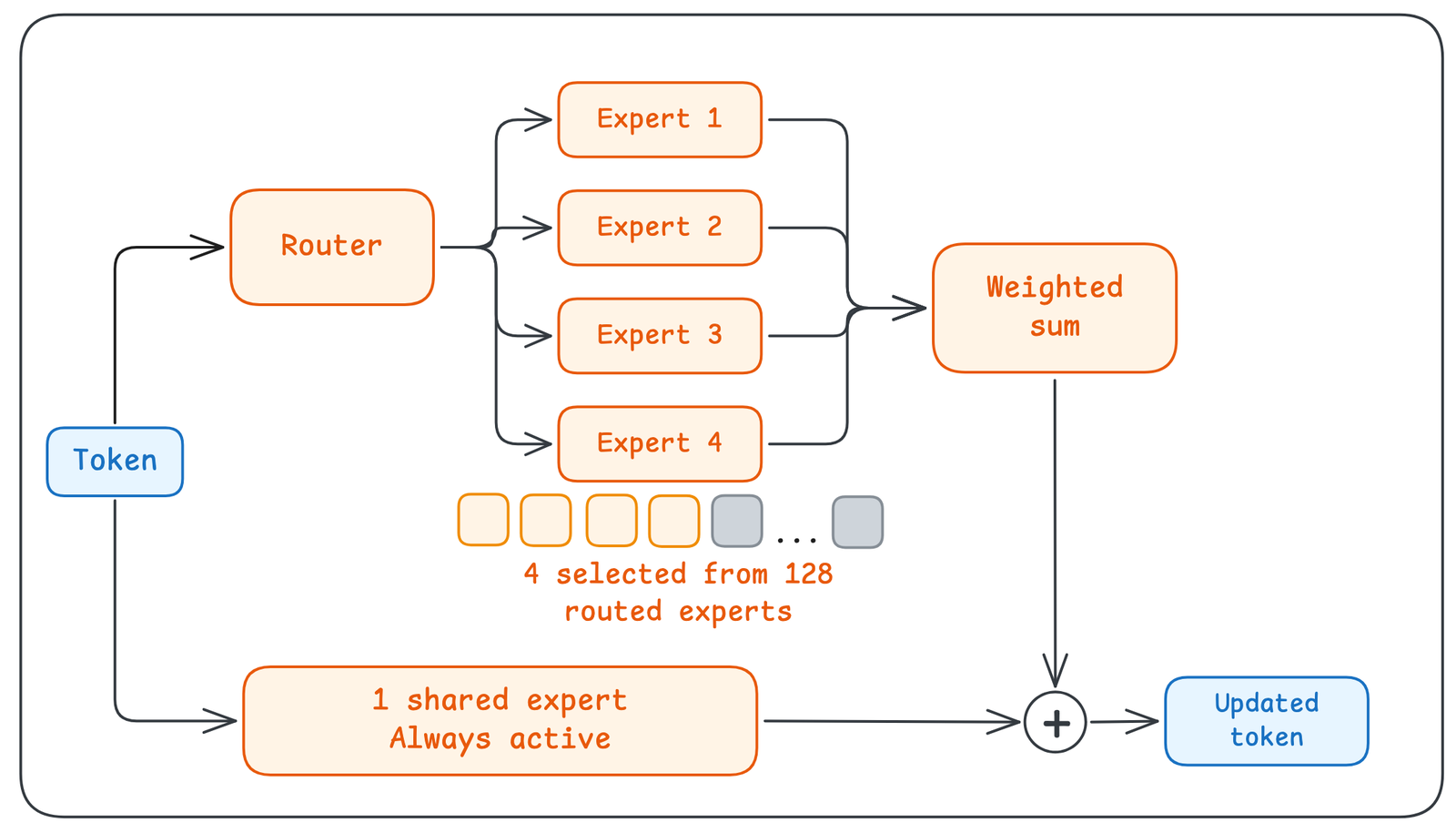
- What it is: a sparse Mixture-of-Experts model with about 1T total parameters and 49B active per token (52B counting embeddings and output layers).
- Who can use it: anyone can download, fine-tune and deploy it, including commercially, under the Mistral Ecosystem Open-Weight License. Running a Model-as-a-Service business on it needs a separate licence.
- API price: $0.70 per million input tokens, $0.07 cached input and $2.10 output on Mistral's platform.
It joins a busy run of large open-weight releases, including Moonshot's Kimi K3.1 Pro and Meta's Muse Spark Open.
Specs: 128 experts, 1M context, 160+ languages
According to the official model card, Mistral Large 4 was trained from scratch on 3,800 NVIDIA Grace Blackwell GPUs in Mistral's own European datacenters.
- Mixture of Experts: 128 routed experts with 4 active per token, plus 1 shared expert that always runs. The Hugging Face launch blog explains that the first decoder layer is dense and the other 71 use MoE blocks.
- Context: 1M tokens.
- Input: text and images, with text output (Pixtral-style vision encoder).
- Languages: 160+, including every official EU language.
- Reasoning modes: low, medium and high (default), so you can trade accuracy for cost.
Coding: the best open model, per Mistral
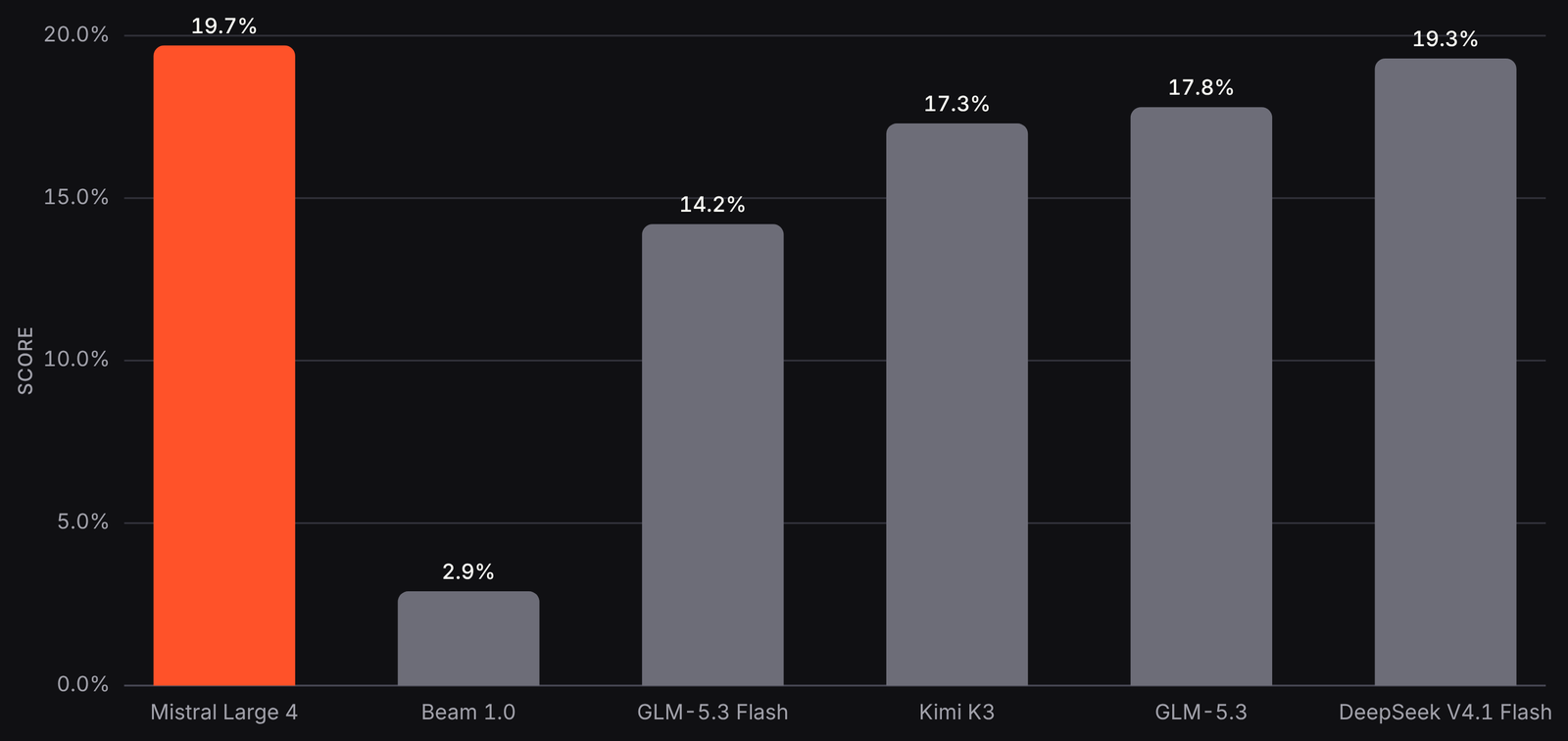
FrontierCode 2.0: 19.7%
On Cognition's private FrontierCode 2.0 benchmark, which judges end-to-end code quality and whether a maintainer would merge the change, Mistral Large 4 scores 19.7%, just ahead of DeepSeek V4.1 Flash (19.3%), GLM-5.3 (17.8%) and Kimi K3 (17.3%). For more on that DeepSeek model, see our piece on DeepSeek V4.1 Flash 1017.
Same score, about half the tokens
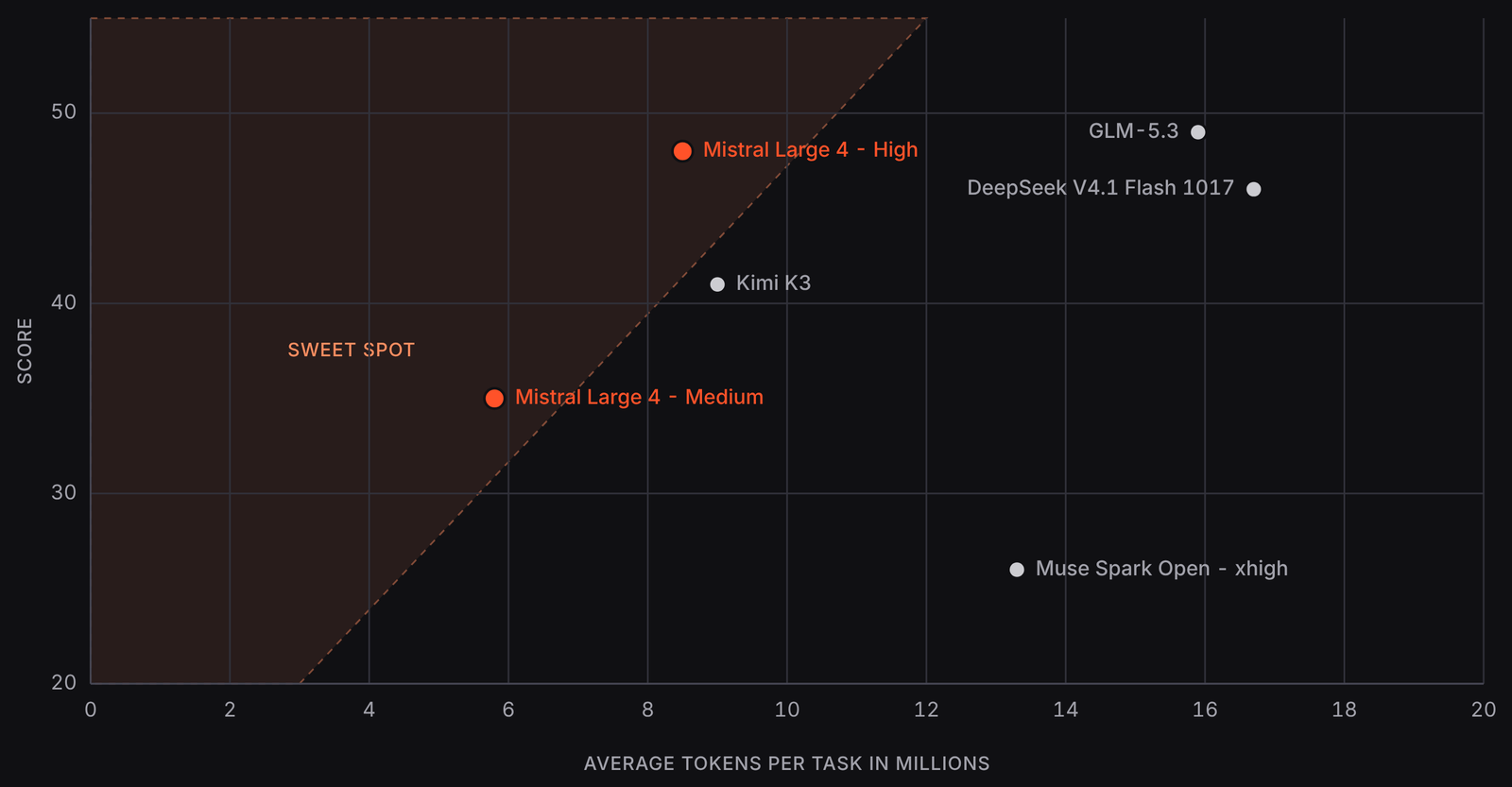
On the Artificial Analysis Coding Agent Index, Mistral Large 4 scores 48%, effectively tied with GLM-5.3 (49%), while using 47% fewer tokens per task on average. Fewer tokens means cheaper and faster coding agents.
Terminal-Bench 4.0: 41%
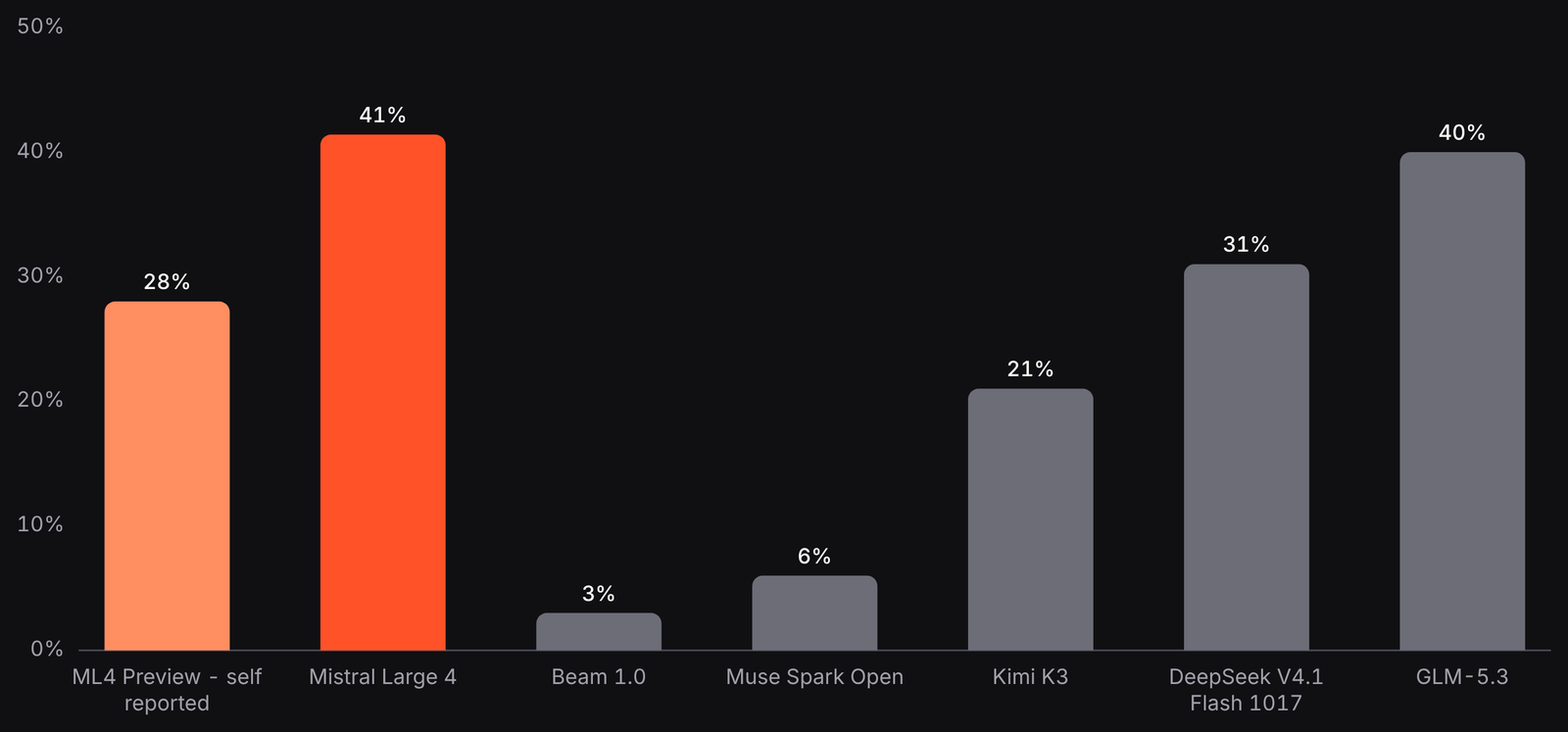
On Terminal-Bench 4.0 the model jumped 13 points to 41% compared with the preview, the top score among open models (GLM-5.3 has 40%), while using 30% fewer output tokens. In Surge's blind side-by-side tests, graders preferred it over GLM-5.3 and Kimi K3 in 64% of prompts and over DeepSeek V4.1 Flash in 56%. Only Claude Opus 5.5 ranked above it.
Cyber defense: strong, but it says no to attackers
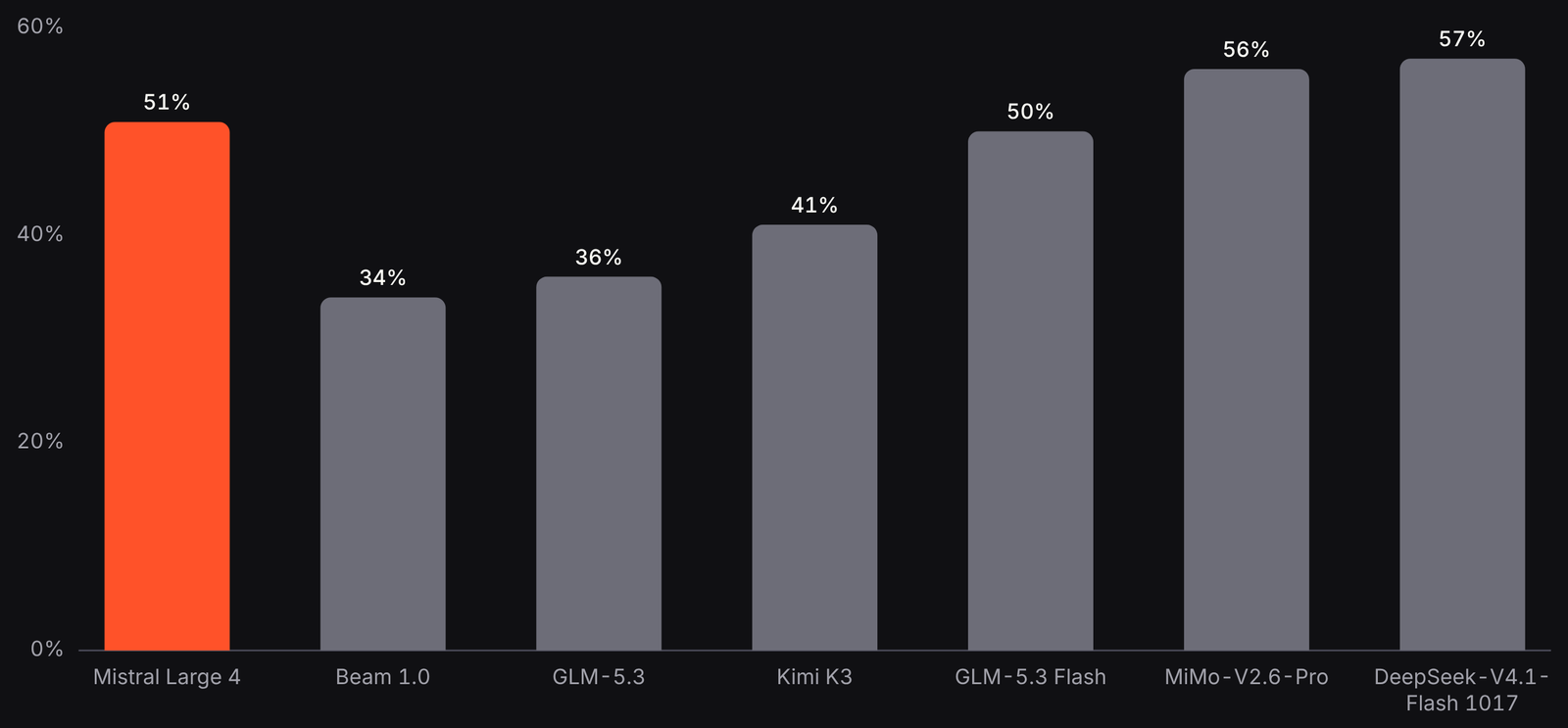
Mistral spent the preview period testing the model with security vendors. It scores 51% on the Artificial Analysis Cyber Index, which measures finding, reproducing and patching vulnerabilities. That is not the top score: in Mistral's chart DeepSeek V4.1 Flash 1017 (57%) and MiMo-V2.6-Pro (56%) are ahead. Mistral's pitch is the balance between that capability and safety.
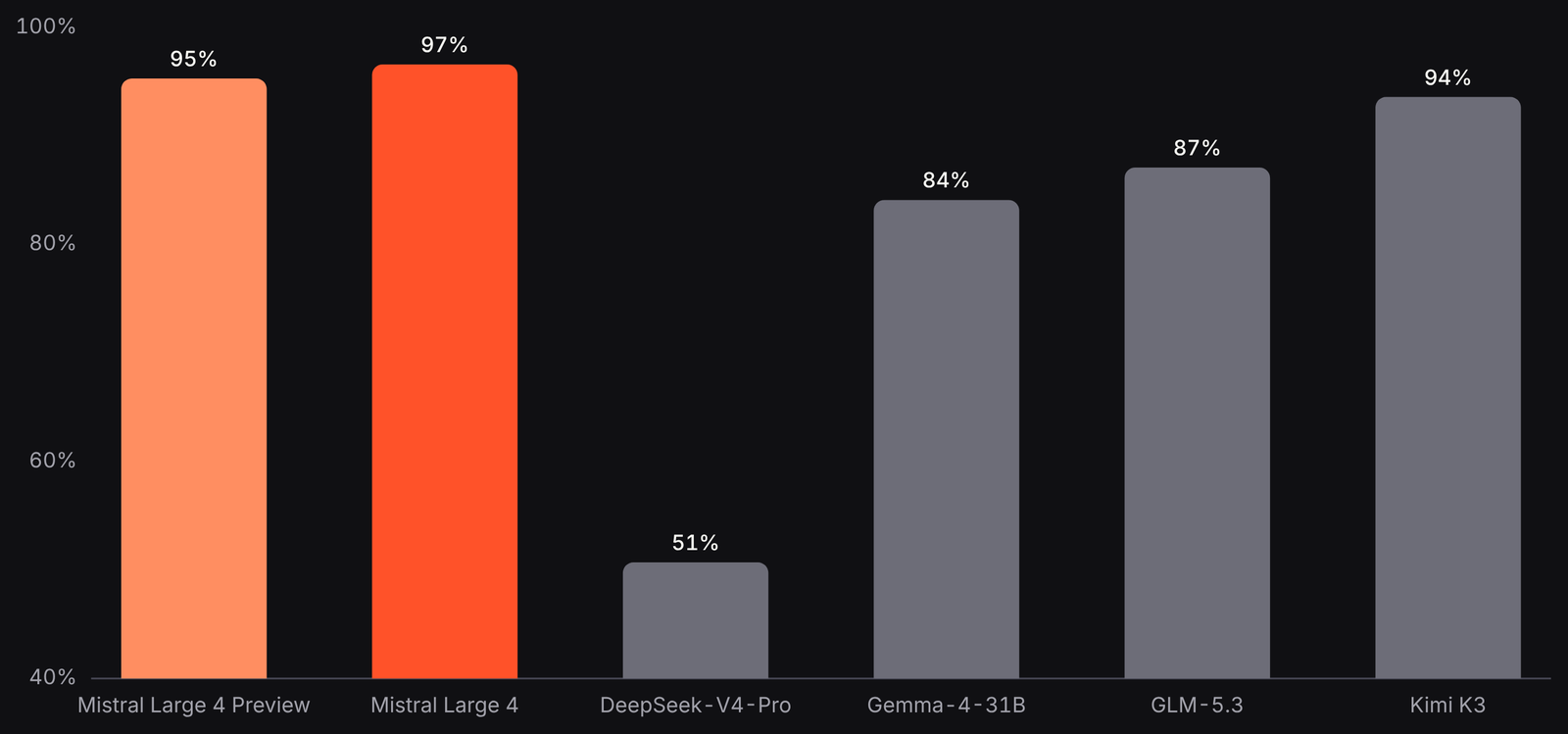
- Refusals: an average 96.6% refusal rate on malicious cyber requests (cyber prompts from JailbreakBench, StrongREJECT and AgentHarm), which Mistral says is the highest it measures among open models, while still doing legitimate defensive work.
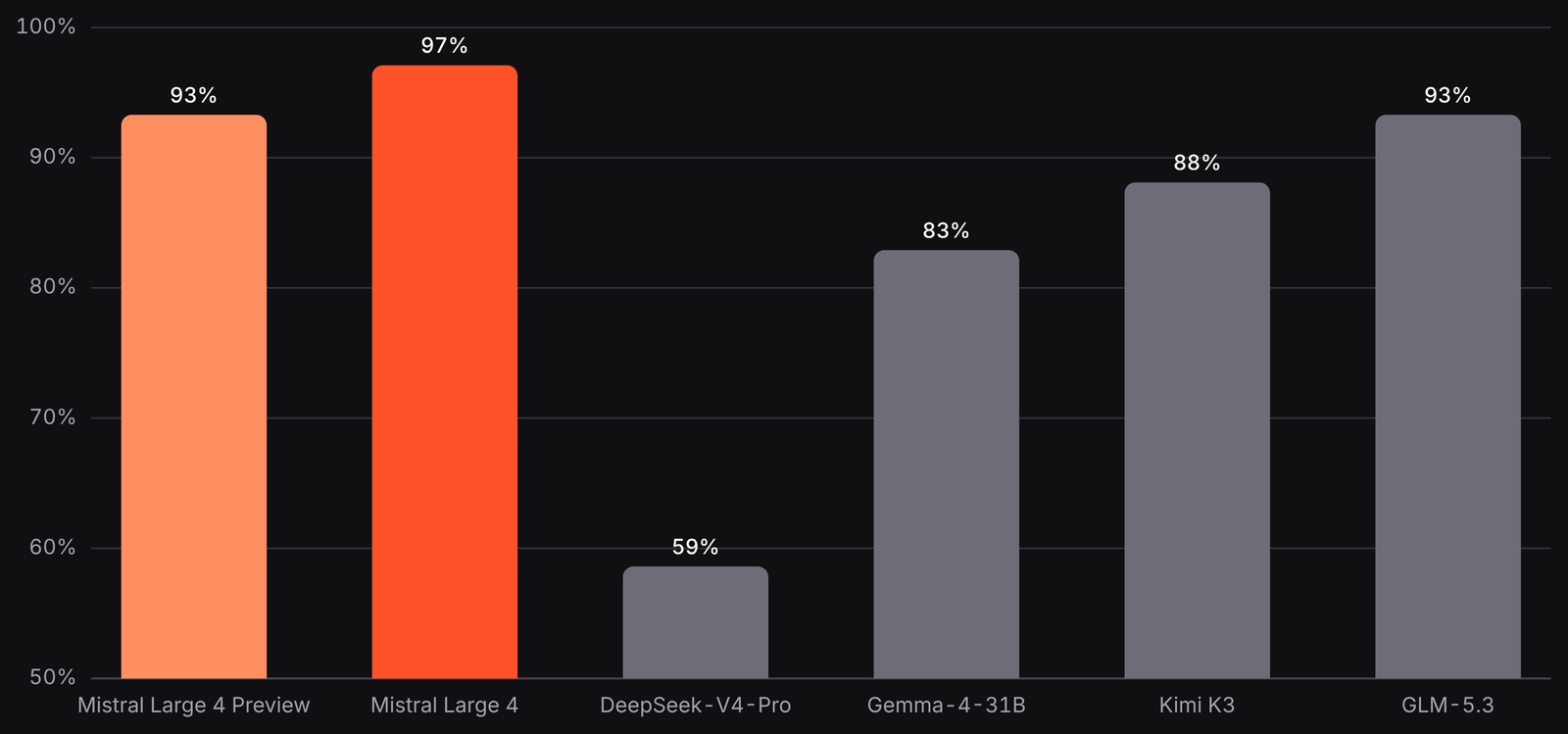
- Agent security: it resists 97.1% of attacks on the B3 Agent Security Benchmark (93.3% for the preview), such as system-prompt exfiltration and malicious code injection.
- Partners: Booz Allen Hamilton, Cisco, Cloudflare, CrowdStrike, Elastic, Fortinet, Rubrik, Zscaler and the EU cyber agency ENISA all gave statements; Booz Allen says it matched other frontier cyber models on vulnerability detection recall "with a compelling cost curve".
Work tasks: spreadsheets and browsing
- Finance: 73.3% on FinWorkBench (Finch), second among open models to Kimi K3 (77.3%).
- Web browsing: 84.5% on BrowseComp, up from 75% for an early checkpoint, ahead of GLM-5.3 and DeepSeek V4.1 Flash but behind Kimi K3 (91.2%).
Where to run it
- Hosted: Mistral Studio and API, OpenRouter, NVIDIA's API catalog and Microsoft Foundry, which Mistral says is the first cloud to offer it.
- Self-hosted: vLLM and SGLang. The SGLang cookbook verifies FP8 on 8× NVIDIA B300 and NVFP4 on 4× NVIDIA GB300; Hugging Face Inference Endpoints has an 8× H200 recipe.
- Custom versions: companies can tune it on their own data with Mistral Forge.
The catch
- It's heavy: "open" does not mean "runs on a laptop". Self-hosting needs a full node of top-end data-center GPUs.
- Licence limits: commercial use is allowed, but a Model-as-a-Service business needs a separate commercial licence from Mistral.
- Misuse risk: Mistral says it saw "a potential for uplift to conduct real attacks" in live traffic and is tightening guardrails over the coming months. A specialized cyber variant for penetration testing goes only to vetted partners such as Orange Cyberdefense.
- Mistral's own numbers: the scores come from Mistral's launch post. Wait for independent testing.
Why it matters
Mistral is betting on "sovereign AI": a frontier-scale model trained in Europe that banks, governments and security teams can inspect and run on their own hardware. If the coding and refusal numbers hold up in independent tests, Le Chonk becomes one of the strongest open options for coding and defensive security. Catch up on the rest of the month's releases in our 18 AI launches in one month roundup, and see how it compares with Google's closed Gemini 4 Carbon, also aimed at cyber defenders.
Sources
- Mistral AI: Mistral Large 4 (Le Chonk) is now open weight (October 29, 2026)
- Hugging Face: mistralai/Mistral-Large-4-1T-A52B model card
- Hugging Face blog: Welcome Mistral Large 4
- SGLang cookbook: Mistral Large 4
- TechCrunch: Mistral releases weights for its trillion-parameter AI model targeting cybersecurity
Frequently asked questions
What is Mistral Large 4 (Le Chonk)?
Mistral Large 4, nicknamed Le Chonk, is Mistral AI's flagship open-weight model, released on October 29, 2026. It is a Mixture-of-Experts model with about 1 trillion total parameters and 52B active per token, a 1M-token context and text plus image input.
Is Mistral Large 4 free to use?
The weights are free to download on Hugging Face under the Mistral Ecosystem Open-Weight License, a modified MIT licence that allows commercial use. Running a Model-as-a-Service business on it needs a separate commercial licence from Mistral.
How good is Mistral Large 4 at coding?
Mistral reports 19.7% on Cognition's FrontierCode 2.0 and 41% on Terminal-Bench 4.0, both the best among open models, plus 48% on the Artificial Analysis Coding Agent Index with 47% fewer tokens per task than GLM-5.3.
What hardware do I need to run Mistral Large 4?
SGLang's verified recipes run the FP8 version on 8 NVIDIA B300 GPUs and the NVFP4 version on 4 NVIDIA GB300 GPUs. Hugging Face also has an 8x H200 Inference Endpoints recipe.
How much does the Mistral Large 4 API cost?
On Mistral's platform it costs $0.70 per million input tokens, $0.07 per million cached input tokens and $2.10 per million output tokens.
From the blog
View all posts
Google's Gemini 4 Carbon: #1 Frontier Model, Built for Cyber Defense, and the Catch
On October 28, 2026, Google announced Gemini 4 Carbon, its strongest model yet. It ranks #1 on the Artificial Analysis Intelligence Index v5.0 at 59, leads SEC-bench Pro (88.2%), ExploitGym (54.8%) and CWE-bench (71.0%), and blocked every attack in Gray Swan's prompt-injection test. For now it goes only to vetted cyber defenders. Here are the benchmarks, the safety numbers, the price and the catch.


OpenAI's GPT-6.1 Terra: Half the Price, Built for Computer Use, and the Catch
On October 26, 2026, OpenAI launched GPT-6.1 Terra, a fast, efficient model for computer use, visual reasoning and writing. It costs $1 per million input tokens and $5 per million output tokens, 50% less than GPT-5.6 Terra and GPT-6.1 Sol, scores 15 points higher than GPT-5.6 Terra on Agents' Last Exam and runs over 3x faster than GPT-6 Astra and GPT-6.1 Sol. Here is what it does, what it costs, the benchmarks and the catch.